
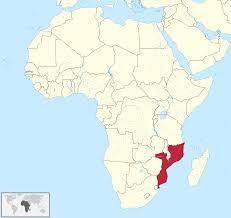
 Security risk in Mozambique is frequently mischaracterized as a national condition. In reality, it is corridor-based, time-sensitive, and unevenly distributed. ARC’s assessment shows that this misreading remains one of the most common causes of flawed entry and expansion decisions.
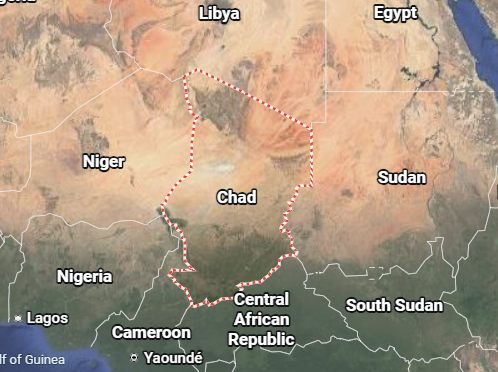
In Chad, Risk Lives Below the National Level
Regulatory Risk in Uganda Is About Timing, Not Just Rules
 Most organizations entering Uganda focus on written regulations. Experienced operators focus on when and how those rules are applied.
Ethiopia’s 2026 Risk Profile Requires Deeper Analysis of Sector Vulnerabilities
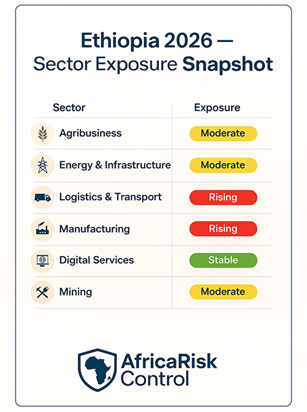 Africa Risk Control (ARC) has reported that Ethiopia’s sector risk variations for 2026 are becoming increasingly pronounced, requiring closer examination of vulnerabilities at both national and regional levels.
Why Political Risk in Chad Is Not About Elections
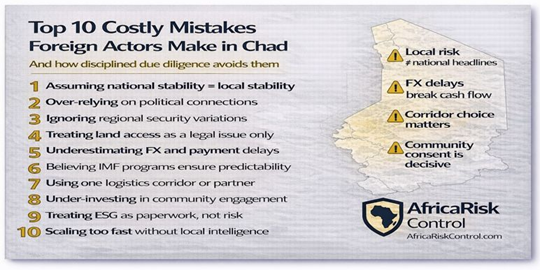 In Chad, elections resolve legal status—but they do not settle legitimacy. President Mahamat Déby’s grip on power entering 2026 is firm, anchored in military cohesion and elite alignment. Near-term regime collapse is unlikely. Yet this stability rests on a narrow base, prioritizing security control over institutional consolidation.
Political Continuity in Mozambique Does Not Mean Predictability
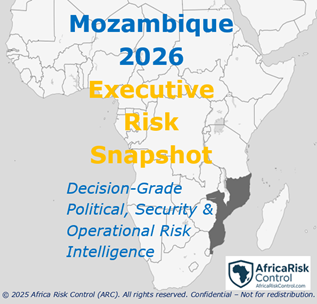 Mozambique’s political system entering 2026 is best described as stable but discretionary. FRELIMO’s dominance remains intact, elections have not altered the balance of power, and regime continuity is not in question. Yet ARC’s assessment shows that political stability has not translated into predictable execution for investors and operators.
Kenya Investment Outlook: Opportunity Endures, but Execution Risk Now Defines Outcomes
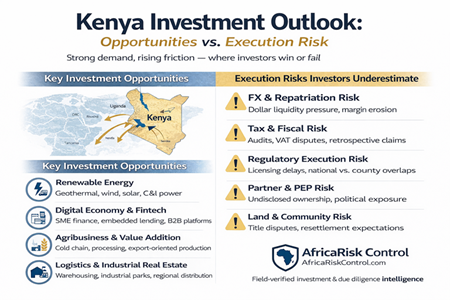 Kenya has long been regarded as East Africa’s most sophisticated investment destination. It hosts the region’s deepest financial sector, the most diversified private economy, and a critical logistics and services hub serving Uganda, Rwanda, South Sudan, eastern Democratic Republic of Congo, and northern Tanzania. For multinational firms, private equity funds, DFIs, and regional operators, Kenya often functions as both a market in its own right and a strategic base for wider African expansion.
Egypt Energy Transition: The 4 Gates to Bankable Investment
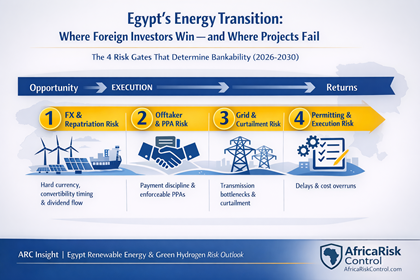 Foreign investment sentiment toward Africa has improved materially over the last 18 months, but Egypt is the market where capital is currently concentrating most decisively—not only because of mega real-estate and infrastructure flows, but because the country is becoming a regional energy-transition hub.
Corridor & Mobility Risk in Ethiopia: A Critical Factor for 2026 Operations
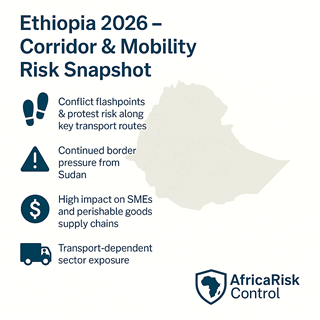 Africa Risk Control (ARC) has highlighted increasing mobility disruptions and corridor volatility that could influence Ethiopia’s transport and logistics sector in 2026. These developments pose a significant challenge for industries dependent on consistent movement of goods.
Understanding Uganda’s Political, Regulatory Stability During 2026 Election Cycle
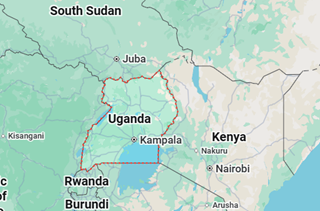 As Uganda approaches a critical election period next month, attention is increasingly turning to how the political environment may evolve beyond the vote itself. Election cycles in Uganda have historically influenced not only political rhetoric but also regulatory behavior, institutional responsiveness, and the overall investment climate.