
The scale of that project alone reshaped continental investment statistics and brought renewed attention to Egypt as a destination for capital, contractors, and suppliers.
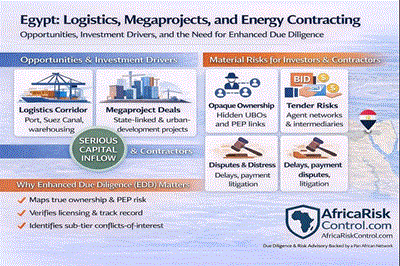
For African and international businesses, however, the renewed focus on Egypt is not simply about the size of investment announcements. It is about what megaproject cycles actually produce in practice: dense procurement ecosystems, multi-layered contracting chains, and intense competition among firms seeking to position themselves as partners, subcontractors, or service providers. These conditions create opportunity—but they also change the risk profile of doing business.
Megaprojects and the Expansion of Procurement Ecosystems
Large infrastructure and real estate projects do not operate in isolation. They generate demand for engineering and construction services, logistics and transport, materials supply, equipment leasing, professional services, security, and a wide range of ancillary activities. As project pipelines expand, so does the number of firms claiming relevance to them.
For Egyptian companies, this creates pathways to scale. For regional African suppliers and international firms, it opens doors to new markets and contracts. But megaproject environments also tend to blur boundaries between prime contractors, subcontractors, agents, and facilitators. The larger and faster the project cycle, the harder it becomes to distinguish between genuine delivery capacity and influence-based access.
This distinction matters because procurement integrity and counterparty reliability determine whether projects are delivered on time and on budget—or become sources of dispute, delay, and reputational damage.
Logistics at the Center of Egypt’s Economic Role
Egypt’s logistics relevance is anchored by its geography. The Suez Canal remains one of the world’s most critical maritime chokepoints, linking Asia, Europe, and Africa. Around it sits a broader ecosystem of ports, industrial zones, warehousing, bonded facilities, and transport corridors that support trade across regions.
Yet the past year has shown how exposed logistics-dependent economies are to geopolitical disruption. In 2024, shipping patterns shifted sharply as insecurity in the Red Sea prompted many vessels to divert away from the Suez route. Traffic volumes and canal revenues reportedly declined significantly as a result. For businesses operating in port services, ship services, storage, and inland logistics, this translated into pressure on revenues and margins.
For investors and partners, the lesson is not that Egypt’s logistics role is diminished in the long term. Rather, it is that disruption changes incentives. In stressed environments, counterparties may face liquidity constraints, renegotiate contracts aggressively, or seek alternative financing arrangements. These dynamics heighten the importance of partner selection and contractual clarity.
Repricing Risk in Infrastructure and Contracting
In megaproject and logistics-linked markets, risk is often repriced quietly. It rarely appears in headline announcements or early-stage memoranda. Instead, it emerges during execution: delayed payments, disputes over variations, unclear subcontracting arrangements, or disagreements over responsibility when conditions change.
Egypt’s infrastructure environment is no exception. As capital flows increase, so does scrutiny—from financiers, regulators, and international partners. Companies seeking to engage in this ecosystem are increasingly assessed not only on technical capability, but on governance, transparency, and track record.
This is particularly relevant for foreign firms entering through partnerships or subcontracting arrangements. In many cases, local partners or intermediaries play a critical role in navigating licensing, permits, customs processes, and regulatory engagement. While such relationships can facilitate market entry, they can also introduce risk if roles, ownership, and incentives are not clearly understood.
The Challenge of Layered Contracting
One of the defining features of megaproject environments is layered contracting. Prime contractors may rely on multiple tiers of subcontractors, each with its own suppliers and service providers. While this structure can improve efficiency and specialization, it also diffuses accountability.Problems often arise at lower tiers, where oversight is weaker and margins are thinner. Payment disputes, labor issues, and compliance failures at these levels can escalate upward, affecting project timelines and reputations.
For businesses seeking to participate in Egypt’s infrastructure and logistics sectors, understanding where they sit within this chain—and how risk flows through it—is essential. Visibility into counterparties’ ownership structures, financial stability, and compliance practices is increasingly treated as a prerequisite rather than an optional safeguard.
Energy Transition and Compliance Sensitivity
Alongside traditional infrastructure, Egypt is positioning itself within broader energy transition narratives. Grid upgrades, renewable energy components, and industrial energy efficiency projects are gaining attention from international partners and financiers.These segments often carry additional compliance sensitivity. Equipment classification, export controls, and sanctions considerations can affect procurement and financing decisions. For firms unfamiliar with these requirements, missteps can delay projects or exclude them from international funding frameworks.
As a result, companies operating at the intersection of infrastructure, logistics, and energy are facing higher expectations around documentation, transparency, and governance.
What This Means for African and International Businesses
For African suppliers, Egypt’s megaproject cycle offers scale and visibility. Participation in high-profile projects can accelerate growth and open doors to further regional opportunities. But it also exposes firms to higher standards of scrutiny and performance.For international investors and contractors, Egypt remains a market of strategic importance. The opportunity is real, but so is the complexity. Success depends less on identifying projects and more on navigating relationships, managing risk, and maintaining credibility throughout execution.
Across both groups, a common theme is emerging: credibility has become a commercial asset. Firms that can demonstrate transparent ownership, verifiable track records, and disciplined governance are better positioned to compete and to weather disruption.
A Market Where Discipline Separates Outcomes
Egypt’s current investment moment illustrates a broader trend across Africa. As markets grow more interconnected and capital flows become more concentrated, the margin for error narrows. Reputational issues, contractual disputes, or governance failures that might once have remained local now carry regional or international consequences.In this environment, the difference between successful participation and costly disengagement is often determined by preparation rather than ambition.
For businesses evaluating opportunities in Egypt’s logistics and infrastructure sectors, the message is clear: the opportunity is significant, but it rewards discipline. Those who invest time in understanding counterparties, structuring relationships carefully, and managing risk proactively are more likely to benefit from Egypt’s megaproject moment. Those who rely on surface signals and informal assurances may find that the real costs only become visible after commitments have been made.
If you are evaluating a partner, EPC contractor, subcontractor, strategic vendor, or key executive in Egypt—especially in logistics, megaproject contracting, ports, or energy-transition infrastructure—ARC can support you with:
Corporate Enhanced Due Diligence (EDD): Beneficial ownership verification, litigation/regulatory checks, sanctions/adverse media screening, site-level verification where required, and integrity risk assessment tailored to the transaction.
Individual Enhanced Due Diligence (EDD): Background verification, PEP and conflict-of-interest mapping, source-of-wealth red-flag review, and reputation risk profiling.