
 Ethiopia is often approached as a frontier market, yet its defining characteristic is not fragility but scale. With a population exceeding 120 million and one of Africa’s largest domestic markets, the country’s economic strategy has long focused on industrialization rather than resource export dependence.
The government’s development model links manufacturing growth to state-led infrastructure expansion. Industrial parks, transport corridors, and electricity generation have been built simultaneously in order to shift the economy from agriculture toward production. This differs from typical resource economies where growth follows commodity cycles. In Ethiopia, growth depends on whether infrastructure, policy, and private investment move at the same pace.
Understanding the country therefore requires viewing it as a coordinated economic system rather than a collection of independent sectors.
Electricity Surplus Is Emerging
The most significant structural change underway is the transition from electricity shortage to electricity surplus.
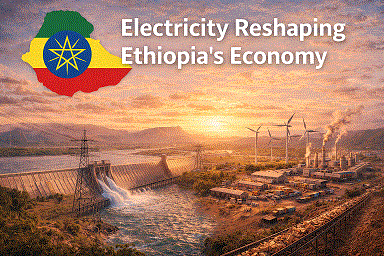
Installed generation capacity rose to nearly 8,000 MW by 2025, with expectations of approaching 9,000 MW as additional turbines come online. The Grand Ethiopian Renaissance Dam alone contributes about 5,150 MW and is expected to produce roughly 15,700 GWh annually, effectively doubling national electricity output.
More than 85–90% of generation comes from hydropower, giving Ethiopia one of the lowest potential industrial electricity costs in Africa. In long-term planning, this energy base is intended to support manufacturing competitiveness rather than simply expand household consumption.
The implication for investors is fundamental: Ethiopia’s economic strategy is built on electricity availability as a production input.
Transmission, Not Generation, Is the Constraint
Despite large generation capacity, electricity access remains below national coverage targets. Roughly half the population has grid access, and the transmission network — about 20,000 kilometers — is expanding but still catching up with new generation.
This shifts the investment logic. The country no longer faces a supply problem; it faces a distribution and utilization challenge.
Industrial parks may operate with reliable power while nearby regions do not. New factories depend not on whether electricity exists but whether transmission upgrades reach them on time. Manufacturing planning therefore becomes closely tied to infrastructure sequencing.
For companies unfamiliar with such environments, projects can appear delayed despite sufficient national capacity simply because local connectivity develops later.
Manufacturing Strategy: Power First, Industry Second
Ethiopia’s industrial parks were designed around anticipated energy abundance. Textile and light manufacturing clusters were the initial phase, but policy has gradually shifted toward import-substitution industries and heavier manufacturing inputs.
The logic is straightforward: inexpensive electricity lowers production costs and reduces foreign currency pressure from imports. The challenge lies in aligning industrial growth with supporting logistics, finance availability, and regulatory procedures.
Unlike export-processing zones in smaller economies, Ethiopian manufacturing depends heavily on domestic infrastructure performance. Factory viability often reflects system coordination rather than individual firm efficiency.
Mining as the Next Export Pillar
While manufacturing anchors employment policy, mining is emerging as a complementary foreign-exchange sector. Gold remains the dominant mineral export, but potash development in the Danakil Depression and exploration for lithium and other minerals indicate broader diversification.
The government aims to formalize production and attract larger operators. However, mining projects interact with the same structural realities as manufacturing: infrastructure rollout, licensing processes, and state-linked counterparties.
For investors, this means resource availability is rarely the primary uncertainty. Project timing and regulatory sequencing are more significant variables.
Regional Power Exporter
The expansion of hydropower capacity positions Ethiopia as a regional electricity supplier. Energy exports are expected to generate significant foreign revenue over time as neighboring countries integrate power imports into their grids.
Electricity trade adds a geopolitical dimension to infrastructure planning. Transmission corridors now carry both domestic industrial supply and cross-border commercial value. Reliability therefore depends on coordination between national utilities and regional agreements.
In practical terms, power infrastructure becomes both an economic and diplomatic asset.
The Real Operating Environment
Ethiopia’s investment environment differs from both mature markets and frontier extractive economies. Projects rarely fail due to lack of demand or resources. Instead, exposure emerges from timing mismatches between components of a coordinated development model.
Common patterns include:
- licenses issued before infrastructure completion
- infrastructure completed before financing cycles align
- production capacity available before foreign exchange access expands
Each element exists, but not always simultaneously. The result is delay risk rather than viability risk.
Companies accustomed to market-driven expansion often expect linear progress. Ethiopia operates through staged implementation, meaning commercial outcomes depend on synchronization rather than individual project performance.
Outlook
Ethiopia’s long-term trajectory is tied to its electricity base. With hydropower potential estimated far beyond current production, the country has positioned itself for decades of energy-driven industrial growth. The success of that strategy depends on converting capacity into utilization — factories operating, mines exporting, and power traded regionally.
The opportunity is therefore structural and gradual rather than speculative. As transmission networks expand and industrial capacity absorbs power, economic activity should deepen across sectors.
What This Means for Investors
Ethiopia offers market scale and low-cost energy but operates through coordinated infrastructure development rather than purely private expansion. With nearly 8,000 MW installed capacity and rising, project success depends on sequencing of regulation, transmission, and financing rather than resource availability alone.
Africa Risk Control supports engagement decisions through pre-entry situational analysis and counterparty verification across regulatory and institutional stakeholders, helping clients understand timing and operational exposure before commitments are made. Explore related country risk analyses and services within the Africa Risk Control platform.