
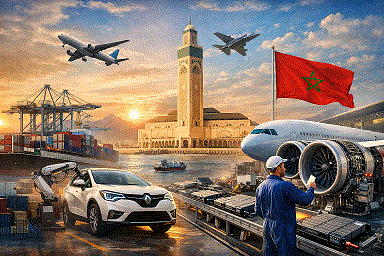
 For two decades, Morocco was viewed mainly as a gateway to tourism, agriculture, and phosphate exports. Today, it is becoming something else entirely — a strategic manufacturing platform embedded inside European supply chains while geographically anchored in Africa.
As global manufacturers reorganize production after pandemic disruptions, geopolitical tensions, and rising Asian labor costs, Morocco has quietly positioned itself as one of the most important near-shoring destinations in the world.
The shift is not accidental. It is the result of sustained industrial policy, logistics investment, and political positioning designed to make the country indispensable to trans-Mediterranean production networks.
From Peripheral Economy to Industrial Platform
Manufacturing now represents a major pillar of Morocco’s exports, surpassing traditional sectors. The transformation accelerated after the Industrial Acceleration Plan created specialized industrial ecosystems rather than generic industrial parks.
At the center of this strategy lies Tanger Med Port — now among the largest ports in the Mediterranean — connected to more than 180 ports globally and capable of delivering components to southern Europe within 24–48 hours.
This logistics speed, rather than labor cost alone, is the real foundation of Morocco’s competitiveness. For European manufacturers, the country functions less as an outsourcing destination and more as a supply-chain extension.
Automotive Sector: Africa’s Largest Vehicle Exporter
Morocco has become the continent’s largest automotive exporter and one of the fastest-growing production hubs globally.
Major assemblers — including Renault and Stellantis — operate high-capacity plants across Tangier and Kenitra. Around them sits a dense ecosystem of more than 250 suppliers producing wiring systems, seats, dashboards, electronics, and metal components.
The sector exports overwhelmingly to Europe, which absorbs the majority of vehicles produced. This integration into European demand cycles makes Morocco less an independent auto market and more a manufacturing node within EU industrial planning.
The next phase is electric mobility.
European regulations phasing out combustion engines are pushing manufacturers to relocate EV supply chains closer to their primary markets. Morocco is now attracting battery and electric component investors seeking a politically stable, trade-connected production base outside Asia.
Aerospace Sector: Small but Strategically Critical
While smaller than automotive, aerospace manufacturing is more technologically significant.
More than a hundred companies operate in the Casablanca aerospace cluster producing aircraft wiring systems, fuselage components, precision machining parts, and maintenance services. Global manufacturers — including Airbus and Boeing suppliers — rely on Moroccan facilities for critical components.
The industry’s importance lies in its position within high-value manufacturing. Unlike automotive assembly, aerospace production integrates Morocco directly into engineering-grade supply chains that require certification, traceability, and technical training pipelines.
This is less about volume and more about strategic industrial capability.
Why Global Manufacturers Are Moving There
Three structural forces are converging:
- Europe seeks to reduce dependence on Asian manufacturing
- Companies want shorter and more predictable supply chains
- Political risk in many regions has increased operational volatility
Morocco offers a rare combination: proximity to Europe, access to African markets, and long-term policy continuity.
However, this positioning also creates vulnerabilities.
Risk Assessment: The Hidden Dependencies
Morocco’s industrial success is tied closely to external demand and geopolitical stability.
Demand Concentration Risk
Most exports depend on European consumption cycles. A slowdown in EU automotive sales immediately impacts production levels.
Regulatory Exposure
European environmental regulations determine investment flows. Changes in carbon border taxes or local-content rules could rapidly reshape competitiveness.
Geopolitical Sensitivity
Regional tensions, particularly around Western Sahara diplomacy, occasionally affect trade relationships and investment sentiment.
Operational Risks for Investors
- Supplier concentration within limited industrial corridors
- Skilled labor shortages in advanced engineering
- Increasing competition from Eastern Europe and Turkey
For investors, Morocco is not a high-risk environment — but it is a highly interconnected one. The primary exposure is external shock transmission rather than domestic instability.
Investment Outlook
Morocco is transitioning from labor-cost competitiveness toward logistics and regulatory alignment competitiveness. The country aims to double vehicle production capacity and expand aerospace engineering capability.
The most promising opportunities lie not in assembly but in:
- component manufacturing
- technical services
- maintenance ecosystems
- supply-chain management operations
Why Due Diligence Matters in Morocco
Because Morocco is deeply embedded in global value chains, risk does not come only from local partners — it comes from structural dependency risks, regulatory exposure, and supplier network vulnerabilities.
Africa Risk Control conducts:
- partner background investigations
- supply-chain mapping
- regulatory exposure assessments
- operational risk forecasting
- geopolitical scenario analysis
Morocco’s automotive and aerospace sectors function as interconnected supply-chain ecosystems rather than isolated markets. Investment outcomes therefore depend not only on the primary counterparty, but on ownership linkages, subcontractor reliability, and regulatory alignment that are often not visible during commercial negotiations.
Africa Risk Control supports market entry through targeted pre-entry situational analysis and investigative due diligence, including partner verification, beneficial ownership checks, and selective on-the-ground validation. Explore our services and related country risk analyses within the Africa Risk Control platform.