
 As the first quarter of 2026 unfolds, Kenya has transitioned from a story of “emerging potential” into a sophisticated, multi-layered marketplace that serves as the undisputed economic engine of the 400-million-person East African Community.
Analysis
South Africa’s Critical Minerals, Energy Transition, and Grid Supply Chain
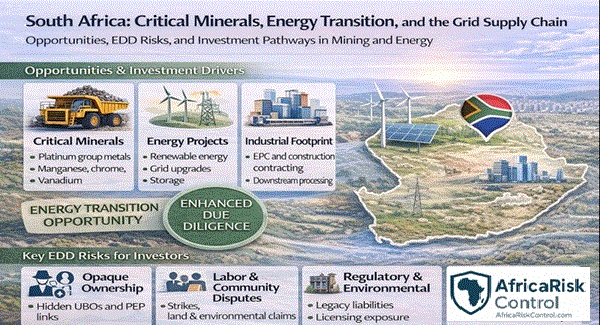 South Africa remains one of Africa’s most strategically important investment destinations, driven by its role in critical minerals supply, industrial capacity, and regional energy infrastructure. Platinum group metals, manganese, chrome, and vanadium position the country at the center of global energy transition value chains.
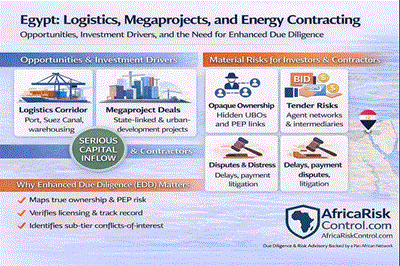
Egypt 2026: Logistics, Megaproject Contracting, and Energy Transition
Nigeria’s Fintech: Opportunities, Risk, and Why Enhanced Due Diligence Determines Outcomes
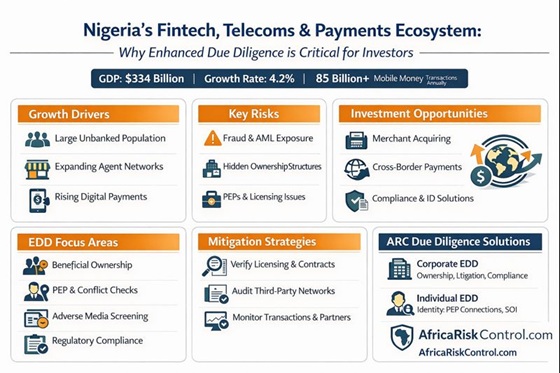 Nigeria’s fintech and digital payments sector has become one of Africa’s most visible investment stories, not because it is fashionable, but because it addresses a structural gap in the economy.
When Citizens Become the Veto: Kenya’s IMF Experience and Implications
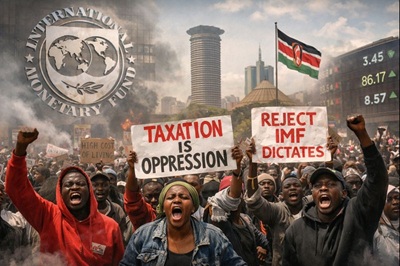 By Africa Risk Control (ARC)- Kenya has not formally exited its relationship with the International Monetary Fund (IMF) though rumors have been spreading. What has changed—and with far greater political consequence—is that citizen resistance has made IMF-aligned austerity measures politically ungovernable.
Kenya Investment Outlook: Opportunity Endures, but Execution Risk Now Defines Outcomes
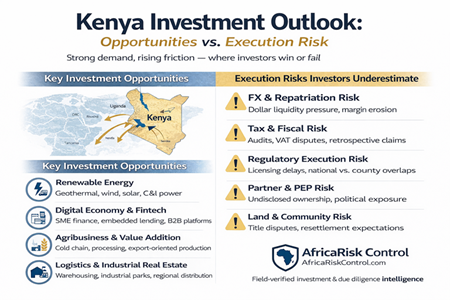 Kenya has long been regarded as East Africa’s most sophisticated investment destination. It hosts the region’s deepest financial sector, the most diversified private economy, and a critical logistics and services hub serving Uganda, Rwanda, South Sudan, eastern Democratic Republic of Congo, and northern Tanzania. For multinational firms, private equity funds, DFIs, and regional operators, Kenya often functions as both a market in its own right and a strategic base for wider African expansion.
Egypt Energy Transition: The 4 Gates to Bankable Investment
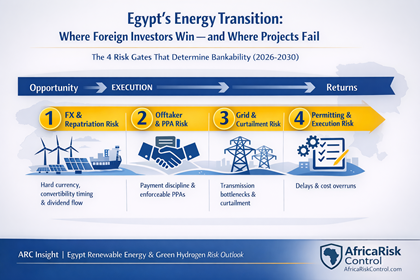 Foreign investment sentiment toward Africa has improved materially over the last 18 months, but Egypt is the market where capital is currently concentrating most decisively—not only because of mega real-estate and infrastructure flows, but because the country is becoming a regional energy-transition hub.
Uganda’s 2026 Elections: Political Trajectories and Investment Implications
 Africa Risk Control (ARC) Investment Risk Analysis – Uganda’s general elections, scheduled for 15 January 2026, arrive at a critical moment for investors assessing East Africa’s medium-term risk outlook. While Uganda remains one of the region’s more resilient investment destinations, election cycles have historically introduced short-term volatility that can materially affect policy execution, regulatory behavior, and operational continuity.
Why Rwanda’s Growth Story Faces New Complexities
 By Africa Risk Control (ARC) – Rwanda’s economic transformation over the past two decades has earned the country widespread recognition for discipline, stability, and reform-driven progress. According to the World Bank’s 2025 Rwanda Country Update, the economy is projected to grow between 6% and 7% in 2026, powered by expanding services, construction, tourism recovery, and a national drive toward digital innovation.
Gold Rush and Deadly Conflicts in Ethiopia, Sudan
 By Africa Risk Control (ARC) – It was one of the warm weekends of mid-June 2025. Khalid (not his real name), a Dubai-based gold trader, was relaxing in a popular nightclub around the bustling Bole area of Addis Ababa. The venue was crowded, the music loud, and the atmosphere electric—typical for a Saturday night in the capital.