
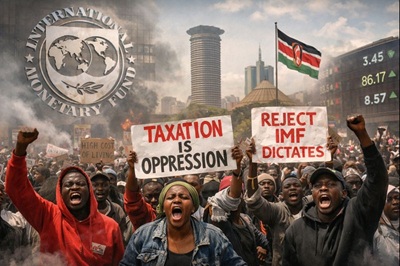
 By Africa Risk Control (ARC)- Kenya has not formally exited its relationship with the International Monetary Fund (IMF) though rumors have been spreading. What has changed—and with far greater political consequence—is that citizen resistance has made IMF-aligned austerity measures politically ungovernable.
Mass protests forced the government to reverse major fiscal proposals, reshaping how economic reform can be pursued in Kenya and sending a clear signal to other African countries implementing similar programs, including Ethiopia. According to IMF balance-sheet data, around 30 African countries had outstanding IMF credit as of late 2025, with only a handful of countries never borrowing from the institution. Three countries — Botswana, Libya, and Eritrea — had never accessed IMF loans, while most others did at some point, often multiple times over decades.
Outstanding IMF credit across African borrowers runs into tens of billions of U.S. dollars, with the largest holders accounting for the bulk of that exposure. For many of these countries, IMF financing has been a key source of external liquidity support amid fiscal pressures, exchange-rate challenges, and broader balance-of-payments constraints.
The widespread engagement with the IMF highlights both the structural financing gaps facing African economies and the political sensitivity of IMF programs when they intersect with policy measures affecting everyday costs — a dynamic exemplified most recently by the public response in Kenya.
Kenya’s outstanding IMF credit rose sharply after 2020, following emergency pandemic financing and a multi-year program approved in 2021. By 2024–2025, Kenya’s total IMF exposure exceeded USD 3 billion, making the IMF one of the country’s largest single multilateral creditors. While IMF loans carry relatively low interest rates, they are tied to fiscal and structural conditions that directly shape tax policy, subsidies, and state-owned enterprise reform—placing IMF programs at the center of domestic political debate.
IMF Power and the U.S. Dimension
IMF governance shapes how reform is perceived on the ground. The United States holds roughly 16.5–17% of IMF voting power, while major IMF decisions require an 85% super-majority, giving Washington effective veto leverage. By contrast, all African countries combined hold about 6–7%.
This imbalance matters politically. When IMF programs translate into higher taxes, subsidy removal, and cost-reflective pricing, public anger is often directed not only at national governments but also at a U.S.-anchored financial architecture seen as setting the rules.
Kenya: IMF Financing, Policy Choices, and Social Impact
From 2020 to 2025, Kenya received over USD 3 billion in IMF financing, beginning with emergency pandemic support and followed by a multi-year Extended Fund Facility/Extended Credit Facility arrangement expanded in 2023. Over the same period:
- Public debt climbed to roughly 65–70% of GDP.
- Debt servicing absorbed more than half of government revenue.
- Fiscal space narrowed, intensifying pressure for revenue increases and subsidy cuts.
What IMF-aligned reforms meant for households
- Program commitments translated into concrete measures felt immediately by citizens:
- Fuel subsidies removed in late 2022.
- Maize flour subsidies eliminated.
- VAT on fuel raised from 8% to 16%.
- Electricity tariffs increased under cost-reflective pricing.
- New levies proposed on wages, housing, digital services, and consumption.
The effects were stark:
- Petrol prices peaked near KSh 182 per litre in early 2023.
- Staple food prices surged; maize flour prices roughly doubled within two years.
- Surveys indicated over 70% of households in serious financial distress.
Citizen Resistance and the Collapse of Policy Consensus
The breaking point came with the Finance Bill 2024, designed to raise about USD 2.7 billion through new and higher taxes. The response was unprecedented: nationwide protests, heavy youth participation, and violent clashes. The outcome was equally unprecedented—the government withdrew the bill entirely.
Earlier, fuel subsidies removed under IMF guidance were quietly reinstated after public anger mounted. These reversals demonstrated a decisive reality: fiscal reforms that raise daily living costs without broad social consent are politically unsustainable, regardless of their macroeconomic rationale.
What This Means for U.S.–Kenya Relations
Kenya remains a strategic U.S. partner in security and regional diplomacy. The protests did not target the bilateral relationship; they targeted a model of economic governance associated with austerity and external influence.
Three implications follow:
- Domestic legitimacy now constrains reform: Future governments will be cautious with IMF-style measures that hit fuel, food, and utilities.
- Association risk for the IMF—and indirectly the U.S.: Unpopular reforms are widely perceived as part of a U.S.-dominated system, even without direct U.S. involvement.
- More selective economic engagement: Kenya is likely to diversify financing and policy advice while maintaining security cooperation with Washington.
Ethiopia: A Parallel Path, a Clear Warning
Ethiopia’s IMF exposure is similarly significant and more recent. In 2024, Ethiopia entered a USD 3.4 billion Extended Credit Facility arrangement with the International Monetary Fund, following severe debt distress and external financing pressures. By early 2025, over USD 1.6 billion had already been disbursed, with additional tranches conditional on continued reforms including exchange-rate liberalization, subsidy removal, and utility tariff adjustments. For Ethiopia, IMF financing is tightly linked to broader debt restructuring efforts and macroeconomic stabilization, making IMF conditionality especially influential over near-term economic policy.
Ethiopia’s USD 3.4 billion IMF Extended Credit Facility in 2024 program include:
- Exchange-rate liberalization, with a sharp currency adjustment.
- Fuel subsidy removal.
- Electricity tariff hikes projected to more than double household bills by 2028.
- Commercialization and pricing reforms at state-owned enterprises, including Ethio Telecom.
These steps mirror Kenya’s sequence—technically coherent, socially sensitive. While Ethiopia has not seen Kenya-scale protests, inflation and rising utility costs are increasingly visible. Kenya’s experience shows how quickly reform fatigue can become political crisis if social cushioning lags.
Alternatives: Can China or BRICS Replace the IMF?
The IMF is not an infrastructure bank. Its advantage is rapid balance-of-payments support and confidence restoration. It maintains a lending capacity approaching USD 1 trillion, allowing swift deployment during currency or debt stress. This function is difficult to replicate quickly. China’s Africa lending—large historically, more cautious now
- China has been a major infrastructure financier in Africa:
- ~USD 182 billion committed to African borrowers from 2000 to 2023.
- Peak years (2013–2018) often exceeded USD 10 billion annually.
- In 2023, new commitments were ~USD 4.6 billion, reflecting a shift toward smaller, risk-managed deals.
Top cumulative borrowers over the long period include Angola, Ethiopia, Egypt, Nigeria, and Kenya, with lending concentrated in energy and transport. China’s recent posture emphasizes risk mitigation and restructuring over rapid expansion.
BRICS New Development Bank (NDB)The BRICS New Development Bank is a project lender. It approved ~USD 2.1 billion in 2023 and ~USD 35 billion cumulatively. This is meaningful for projects but too small to substitute for IMF-style crisis stabilization in the short term.
China and the NDB can complement IMF financing—especially for infrastructure—but they do not quickly replace the IMF’s liquidity, confidence, and debt-rollover role during acute stress. Countries seeking policy space must therefore divers shows financing rather than rely on a single alternative.
Geopolitics: U.S.–China Competition and Africa’s Policy Space
Kenya’s citizen-driven pushback sits within a broader contest for global influence:
- The IMF remains central to a U.S.-anchored financial order.
- China’s infrastructure-first model offered an alternative narrative, though lending volumes have moderated.
- Africa increasingly operates in a multipolar financing environment—with options, but also trade-offs in scale, speed, and purpose.
- This competition expands choice, but it does not eliminate constraints. Policy legitimacy—not lender identity alone—has become the decisive factor.
In conclusion, Kenya’s experience is not a formal rupture with the IMF. It is more consequential than that. Citizens have become the effective veto point in economic reform. The withdrawal of major tax measures under public pressure marks a shift that governments, the IMF, and major shareholders must internalize.
For Ethiopia and others, the lesson is clear: reform without legitimacy is unstable. For the United States, Kenya’s episode underscores a new reality—economic influence exercised through IMF frameworks now faces democratic limits on the ground.