
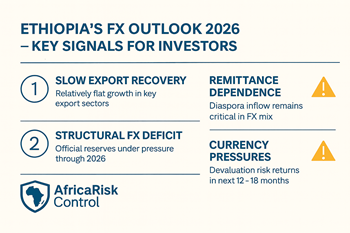
 Ethiopia’s investment outlook for 2026 will depend heavily on how political, security, and economic challenges evolve across the country, according to new analysis from Africa Risk Control (ARC). The firm’s latest Ethiopia Country Risk & Due Diligence Report highlights several emerging issues that investors and development partners must prepare for in the months ahead.
One of the most significant factors shaping 2026 prospects is the ongoing political recalibration between federal and regional authorities. These shifts affect licensing, administrative decision-making, and institutional responsiveness. ARC notes that investors relying on past assumptions may face unexpected delays or governance inconsistencies as these dynamics continue to evolve.
FX shortages remain a second major challenge. Companies dependent on imported inputs, spare parts, equipment, or raw materials report rising operational pressure as procurement timelines extend and liquidity constraints tighten. ARC’s analysis suggests that FX-linked disruptions will continue affecting sectors such as manufacturing, agribusiness, logistics, and construction.
Localized conflict dynamics further complicate Ethiopia’s business climate. While national indicators appear relatively stable, region-level variations—ranging from community tensions to intermittent clashes—affect movement, supply chains, and project implementation. For many businesses, these localized disruptions represent the largest operational risk for 2026.
ARC also highlights the influence of external pressures, particularly from the ongoing conflict in Sudan. Border-area dynamics affect mobility, informal trade, transport corridors, and humanitarian operations in Ethiopia’s northwestern districts. These factors are increasingly shaping business timelines and cost structures.
Despite these challenges, Ethiopia retains strong long-term potential. High-growth sectors—such as digital services, agribusiness, renewable energy, and logistics—continue to attract investor interest. However, ARC warns that 2026 will require stronger due diligence frameworks and continuous monitoring to navigate shifting realities.
ARC’s Ethiopia 2026 Premium Report provides detailed analysis of political, economic, security, and operational developments, offering investors a comprehensive risk assessment for the year ahead.