
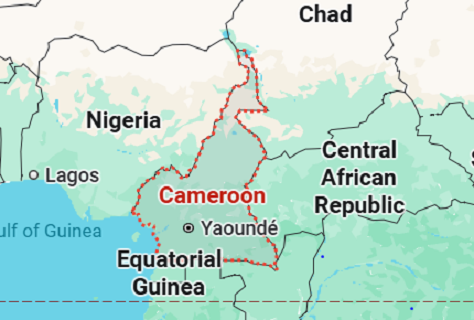
 By Africa Risk Control Central Africa Desk – Cameroon, often described as a gateway to Central Africa, is steadily positioning itself as a hub for regional investment. With a population approaching 29.9 million in 2025, a young median age of just 18 years, and an urbanization rate of nearly 60 percent, the country offers both a growing consumer base and a youthful workforce.
Its economy, valued at around US$51 billion in 2024, continues to expand at a moderate pace, driven by agriculture, energy, and services. Nominal GDP per capita is still modest at roughly US$1,500, but rising incomes and regional trade integration signal important market shifts for investors seeking long-term opportunities.
Agriculture and Agro-processing
Agriculture is the backbone of Cameroon’s economy, employing the majority of the labor force and contributing significantly to export earnings. Cocoa, coffee, cotton, bananas, and palm oil remain core crops, but the country has been making deliberate efforts to move beyond raw exports. The government’s incentives for agro-industrial zones and tax breaks for processing industries reflect a strategy to capture more value within the country.
For investors, this presents a dual opportunity: tapping into large-scale export commodities while also supporting domestic food security. International agribusiness firms and local cooperatives are actively seeking partners for processing facilities, storage infrastructure, and input supply chains. The demand for organic and sustainably produced crops is also creating niches for investors targeting premium markets in Europe and Asia.
Energy and Infrastructure
Energy and infrastructure are arguably Cameroon’s most urgent and attractive sectors for investment. Hydropower potential remains underutilized, and rural electrification levels lag behind urban demand. Projects supported by multilateral lenders and the European Union, including the recent €91 million (about US$96 million) infrastructure financing package, aim to modernize ports, roads, and energy transmission.
Private investors have already engaged in the Kribi deep-water port and related logistics hubs, and there is significant room for new entrants in renewable energy, particularly solar mini-grids that can serve underserved rural populations. Transport infrastructure remains a bottleneck, but new road and rail projects linking Douala and Yaoundé to landlocked Central African neighbors could transform Cameroon into a true regional trade hub.
Technology and the Digital Economy
Cameroon’s digital transformation is less visible than in East Africa’s “Silicon Savannah,” but it is accelerating. Mobile penetration continues to rise, fintech solutions are gaining traction, and government policy under the “Digital Cameroon” strategy seeks to expand broadband access. Startups in e-commerce, telemedicine, and edtech are responding to the country’s youthful demographics and growing urban middle class.
Telecommunications firms such as MTN Cameroon and Orange are leading infrastructure investment, while smaller fintech companies are innovating in mobile payments. This blend of large-scale operators and nimble startups creates fertile ground for partnerships and equity investment.
Extractives and Natural Resources
Cameroon’s extractive industries still command investor interest. Oil and gas remain important, with new gas exploration projects being considered for both domestic use and liquefied natural gas exports. In addition, minerals such as bauxite, iron ore, cobalt, and nickel are increasingly attractive given global demand for inputs into renewable energy technologies and electric vehicles.
While major international oil and mining firms dominate exploration, opportunities exist for service providers, logistics operators, and companies focusing on downstream processing. Responsible forestry investments also remain viable, though sustainability and regulatory compliance are critical given Cameroon’s environmental vulnerabilities.
Real Estate and Consumer Markets
Urbanization is reshaping Cameroon’s consumer landscape. Cities such as Douala and Yaoundé are experiencing growing demand for affordable housing, retail space, and commercial property. Supermarket chains and consumer goods companies are scaling operations to serve a population whose purchasing power, though limited, is gradually expanding. Real estate developers who can combine affordability with scale are well positioned to capture long-term gains.
Risks and Mitigation
Despite these opportunities, Cameroon is not without serious challenges. Political tensions in the Anglophone regions continue to undermine stability and investor confidence. Governance issues, particularly around corruption and bureaucratic hurdles, remain systemic. Infrastructure gaps, currency risks tied to the CFA franc, and exposure to climate shocks such as floods and droughts add further complexity.
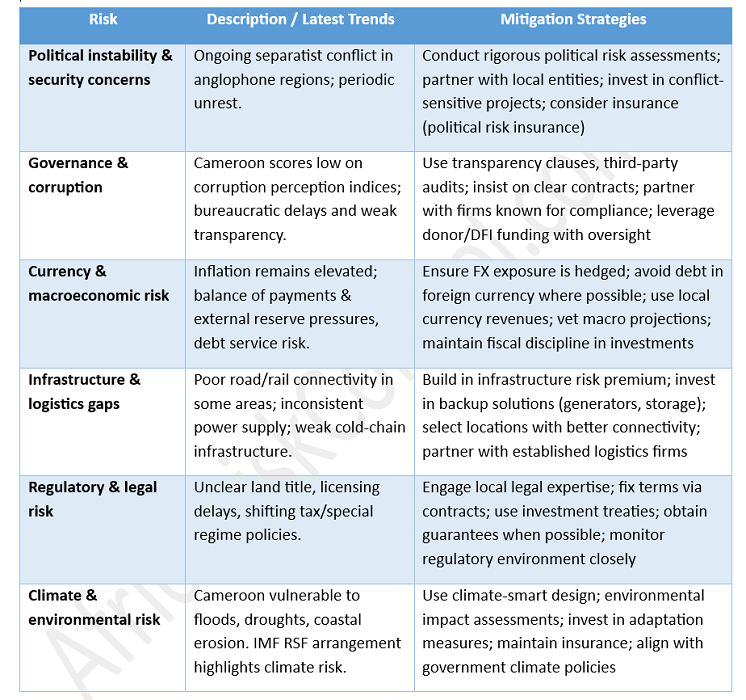
Mitigating these risks requires a deliberate strategy. Investors entering Cameroon are advised to conduct thorough due diligence, ideally in partnership with firms that have strong local networks and investigative capabilities. Political risk insurance can offer protection against instability, while careful structuring of contracts and joint ventures can reduce governance and regulatory risks. Currency exposure can be managed by balancing foreign and local financing, and environmental risks can be addressed through climate-resilient infrastructure design and insurance products.
In conclusion, Cameroon sits at a crossroads. It is a country rich in natural resources and cultural diversity, with a growing population that demands more goods, services, and infrastructure. Its agriculture and extractive industries remain strong, while technology, energy, and real estate are poised to shape the next chapter of growth. For international investors, the rewards are tangible, but so are the risks.
At Africa Risk Control, we help investors cut through uncertainty with investigative due diligence, risk assessment, and actionable market intelligence, ensuring that investment decisions are both informed and sustainable.