
 By Africa Risk Control – Côte d’Ivoire (Ivory Coast) is emerging as one of West Africa’s most dynamic investment destinations. With a population of approximately 32.7 million people as of mid-2025, the country is growing fast — about 2.4% per annum.
Its Gross Domestic Product (GDP) (nominal) was about US$78.9 billion in 2023, with real GDP growth of ~6.2% that year. GDP per capita stood around US$2,300 nominal, with purchasing power parity (PPP) estimates significantly higher (over US$7,000-US$8,000) depending on the source.
Urbanization is accelerating: nearly 49% of the population lives in urban areas, and the median age is young — about 18.3 years.
Inflation has been relatively contained, fiscal deficits reduced, and public debt has remained at manageable levels (~60% of GDP).
These macro-factors establish a strong foundation: rising domestic demand, a youthful workforce, and room for growth across infrastructure, agriculture, energy and manufacturing.
Opportunities for Investors
(Abbreviations used: GDP = Gross Domestic Product; PPP = Purchasing Power Parity; FDI = Foreign Direct Investment; IPP = ; DFIs = Development Finance Institutions; ESG = Environmental, Social, Governance; ECOWAS = Economic Community of West African States)
– Agriculture & Agribusiness (especially Cocoa)
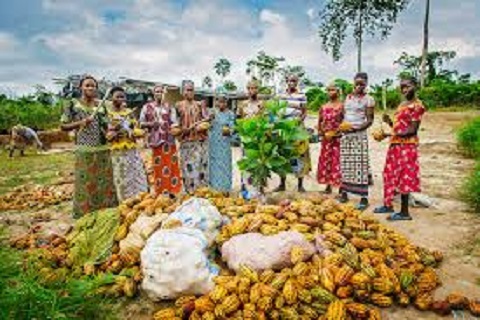
Global leadership: Côte d’Ivoire remains the world’s largest producer of cocoa beans. The 2023/24 season saw approx. 1.76 million metric tonnes (MMT) produced; projections for 2024/25 suggest modest recovery toward ~1.8 MMT.
Value‐chain potential: Opportunities in processing (grinding, refining), specialty cocoa, sustainable sourcing, traceability and certifications. Margins tend to increase when value is captured locally rather than through raw exports.
– Energy (Renewables, Gas & Grid Expansion)
Government and private sector are pushing hydroelectric, solar-PV, and other renewable energy (RE) projects. IPPs are being tendered for large scale solar and hybrid power capacity.
Expansion in generation & distribution to reduce electricity shortage risk; increasing interest from DFIs and multilaterals in financing such projects.
– Transport & Logistics
Abidjan Port remains a key hub – for imports, exports and trans-shipment. Road, rail, bridge infrastructure is a priority.
Cold chain, storage, warehousing and intra-regional transport connectivity (with ECOWAS neighbours) are underdeveloped — offering opportunities for private investment.
– Manufacturing & Consumer Goods
Urban consumption is rising alongside a growing middle class. Demand for processed food, fast moving consumer goods (FMCG), household goods, construction materials is rising.
Import substitution (producing locally goods currently imported) is a strategic play, especially with trade integration via ECOWAS.
– ICT & Financial Services
Mobile money and fintech are scaling rapidly. Digital payments, internet connectivity, SaaS (Software as a Service) for sectors like agriculture, logistics, health offer high growth.
Fintech regulation is evolving; opportunity in cross-border payments and digital infrastructure.
Recent Key Figures & Signals
– GDP growth: ~6% in 2024, exceeding many peers in Sub-Saharan Africa and outpacing global average (~2.8%) and regional average (~3.2%).
– Fiscal metrics: Fiscal deficit improved from ~5.2% of GDP in 2023 to ~4.0% in 2024; public debt around 60% of GDP is considered sustainable.
– Inflation: Moderated to approx. 3.5% in 2024, supported by stable policy and well-anchored expectations.
Future Prospects (3- to 7-Year Horizon)
– Energy transition & power export: RE (solar, hydro) could enable Côte d’Ivoire to not only meet domestic demand but export electricity to neighboring countries.
– Downstream processing in agriculture: Greater local value capture in cocoa, cashews, palm oil, etc., especially under global demand for ‘sustainably sourced’ products.
– Regional manufacturing hub: With infrastructural improvements and improving logistics, Côte d’Ivoire could serve ECOWAS markets for consumer goods.
– Digital transformation: Growth in fintech, broadband, digital services, data centres; rising penetration in rural areas will open new markets.
How We Can Help You Invest Smarter
If you are considering investment in Côte d’Ivoire — whether in agribusiness, energy, logistics, consumer goods or ICT — getting the details right is what separates returns from regrets. We offer:
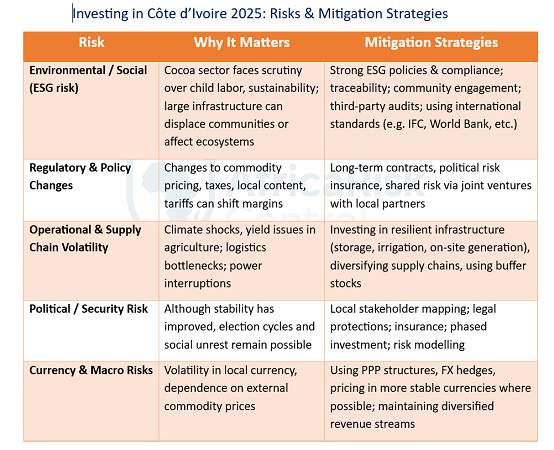
– Transaction-ready due diligence: commercial, legal, ESG, community & political risk reviews
– Project identification and screening: mapping local partners, supply chain, regulatory environment
– Structuring deals for risk mitigation: using joint ventures (JV), DFIs, insurance, offtake agreements
– Stakeholders mapping: On-the-ground stakeholder mapping and impact assessment
…………………….
To Get Similar Analysis Weekly in Your Inbox, Subscribe to Africa Weekly Insights
Trusted Intelligence Across Africa — Uncover Opportunities, Navigate Risks, and Make Informed Decisions. Don’t Miss Out!
[wpforms id=”741″]