
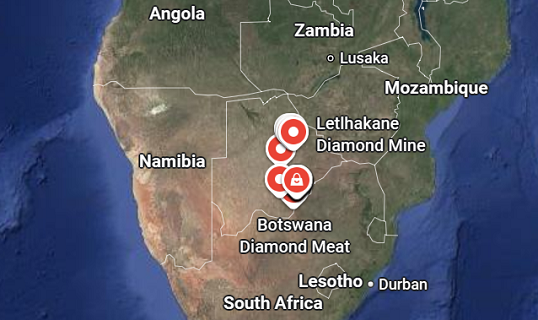
By Africa Risk Control Southern Africa Team – Botswana has long stood out in Africa as a beacon of macroeconomic stability, good governance, and prudent resource management. For decades, its diamond-driven economy — built largely on the Debswana partnership with De Beers — has delivered consistent growth and a reputation for political calm. The country is often cited as one of Africa’s safest investment destinations.
But 2025 marks a significant inflection point. GDP contracted by -5.3% year-on-year in Q2 2025, largely due to weak global diamond demand. Foreign exchange reserves dropped to USD 3.53 billion in July, down almost 27% from the previous year, raising new questions about external buffers. Meanwhile, the government has announced bold new diversification measures, including a citizenship-by-investment (CBI) programme and a new sovereign vehicle to channel resources into non-mineral sectors.
For investors, the message is twofold: Botswana continues to offer clear opportunities in high-value sectors, but the risks are evolving and require sophisticated due diligence.
Key Investment Opportunities
Diamonds and Mining Services
Debswana, the joint venture between De Beers and the Botswana government, remains the backbone of the economy.
Beyond diamonds, copper, coal, and soda ash mining are expanding. Junior miners are increasingly active, especially as Botswana positions itself as a regional mining services hub.
Tourism
Botswana is globally recognized for its low-volume, high-value tourism model. The Okavango Delta and Chobe National Park continue to attract high-spending eco-tourists.
New government incentives are aimed at expanding luxury safari lodges and related infrastructure.
Agriculture and Agro-Processing
Agriculture accounts for a modest share of GDP but is gaining strategic importance.
Government is prioritizing meat, horticulture, and agro-processing industries to reduce dependence on South African imports.
Water-efficient and climate-resilient agribusiness models are being supported with policy incentives.
Financial Services and ICT
Gaborone is positioning itself as a financial hub for Southern Africa, with fintech and digital banking opportunities growing rapidly.
The government is investing in ICT infrastructure, aiming to make Botswana a regional hub for data centres and digital services.
Renewable Energy
Energy diversification is a national priority. Solar projects are gaining traction, supported by international finance institutions.
The Botswana Power Corporation is opening space for independent power producers (IPPs).
Major Players in Key Sectors
Mining:
– Debswana (De Beers + Government) — world’s leading diamond producer by value.
– Lucara Diamond Corp. (Canada) — operates the Karowe mine, renowned for exceptional large-stone recoveries.
– Khoemacau Copper Mining (Cupric Canyon Capital, US) — leading copper-silver producer.
– Minergy — Botswana-based coal company with exports to South Africa and Namibia.
Tourism:
– Wilderness Safaris and Ker & Downey Botswana — major players in luxury safaris.
– High-end joint ventures with international operators, often in partnership with local communities and trusts.
Agriculture:
– Botswana Meat Commission (BMC) — largest beef exporter, with access to EU markets.
– Growing presence of agribusiness investors from South Africa and the Middle East, focusing on horticulture and food security projects.
Financial Services:
– First National Bank Botswana (FNBB), Stanbic Bank Botswana, Absa Botswana — dominant players.
– Letshego Holdings — expanding microfinance and inclusive lending.
– New fintech startups entering with mobile payments and remittances.
Energy & ICT:
– Botswana Power Corporation (BPC) — main power utility, increasingly open to IPPs.
– International renewable developers exploring solar projects.
– Mascom Wireless, Orange Botswana, and BTC Mobile dominate telecoms.
Risks & Challenges
– Commodity Dependence
– Diamonds account for around 80% of export earnings. The Q2 2025 slump underlines Botswana’s exposure to global cycles.
– A failed diamond sale in September 2025 highlights market fragility.
– Foreign Exchange Pressure
– FX reserves dropped to USD 3.53 billion in July 2025, from nearly USD 4.8 billion in mid-2024. While still covering 4–5 months of imports, the sharp decline raises red flags for investors reliant on stable FX flows.
Climate and Water Scarcity
– Botswana is semi-arid, with water scarcity already a key constraint on agriculture and industrial development.
– Climate change will intensify drought risks, increasing costs for agribusiness and infrastructure.
Small Market Size
– With a population of just 2.7 million, Botswana’s domestic market is limited.
– Many investments must be export-oriented to achieve scale.
Governance and Policy Risks
– While Botswana enjoys a reputation for stability, shifts in diamond negotiations with De Beers and the sudden launch of a CBI programme show that policy can move quickly.
– Investors must track government decisions closely.
Regional Competition
– Botswana competes with Namibia, South Africa, and Zambia for investment flows.
– While stability gives it an edge, other markets offer larger consumer bases or better infrastructure.
Risk Mitigation Strategies
Hedging Against FX Risk: Structure contracts with currency adjustment clauses.
– Diversification: Focus on multi-sector exposure (e.g., mining services + tourism + agriculture).
– Local Partnerships: Work with Botswana companies and communities to strengthen social licence to operate.
– Phased Investments: Stagger capital deployment to align with policy clarity and market signals.
– ESG Integration: Strong environmental and governance standards are critical in Botswana’s sensitive ecosystems.
– Regional Outlook: Combine Botswana investments with exposure to larger regional markets to offset size constraints.
Latest Trends — IMF 2025 Article IV Update
The IMF Staff completed its 2025 Article IV mission to Botswana in late September, offering the most recent macroeconomic assessment and policy guidance:
Economic Contraction: Botswana’s economy is projected to contract by ~1% in 2025, primarily due to continued weakness in diamond production.
Inflation Trends: Inflation has remained below the Bank of Botswana’s target range of 3–6% but is expected to return within the range as the recent depreciation of the Pula feeds into consumer prices.
Fiscal Deficit: Preliminary estimates indicate a fiscal deficit of 7.1% of GDP for fiscal year 2024/25, driven by lower mineral revenues and increased current spending.
Public Debt: Rising to over 30% of GDP, debt levels remain manageable but highlight fiscal pressure.
Monetary Policy: Authorities have widened the Pula’s trading margin and adjusted its depreciation against the currency basket to preserve competitiveness and FX reserves.
Banking Sector: The sector remains well-capitalized, but liquidity is tightening. Accelerating implementation of the 2023 Financial Sector Assessment Program is emphasized to reinforce stability.
Structural Reforms: IMF stresses the importance of economic diversification, streamlined government spending, and fostering private sector-led growth to ensure sustainable development.
Investor Implication: These IMF observations confirm the risks already evident in diamond-dependent sectors and highlight the urgency for investors to incorporate FX protection, fiscal awareness, and diversification strategies into project planning.
In conclusion, Botswana remains one of Africa’s safest investment bets, thanks to its political stability and track record of prudent economic management. But 2025 is proving that even Botswana is not immune to commodity shocks and fiscal pressures.
The opportunities — from mining services to fintech, from eco-tourism to solar energy — are real. Yet, capturing them requires rigorous due diligence, FX protection strategies, and climate resilience planning.
……………………………..
To Get Similar Analysis Weekly in Your Inbox, Subscribe to Africa Weekly Insights
Trusted Intelligence Across Africa — Uncover Opportunities, Navigate Risks, and Make Informed Decisions. Don’t Miss Out!
[wpforms id=”741″]