

As Ethiopia approaches 2026, the gap between investor expectations and ground realities is widening. Africa Risk Control (ARC)’s field-level assessments show that many multinational companies, advisors, and development partners continue relying on outdated assumptions formed during the 2021–2023 period. While Ethiopia still presents major long-term potential, the risk environment has shifted—requiring updated intelligence, closer monitoring, and more structured due diligence.
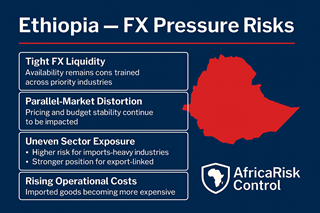 Foreign-exchange pressure has become one of the most decisive macroeconomic variables shaping Ethiopia’s investment climate heading into 2026. While the country’s long-term fundamentals remain compelling, FX constraints continue to influence pricing, working capital, procurement cycles, and overall cost structures across multiple sectors. Today’s ARC Intelligence Insight explores why FX conditions remain a central consideration for investors and operational teams preparing for 2026.
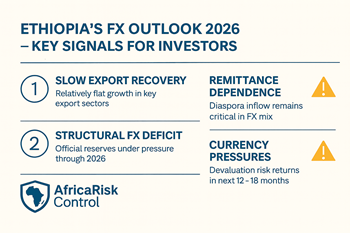 Foreign-exchange pressure remains one of the most defining macroeconomic realities shaping Ethiopia’s investment environment as the country moves toward 2026. Africa Risk Control’s (ARC) latest analysis shows that FX constraints continue to influence operational feasibility, project timing, supply-chain stability, and overall cost structures across multiple sectors. For investors preparing long-term strategies or evaluating market-entry decisions, understanding Ethiopia’s FX trajectory is essential.
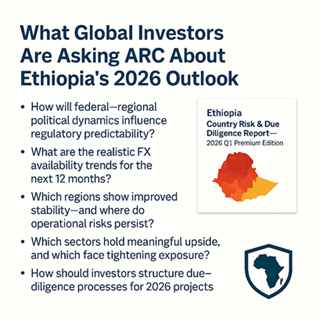 As Ethiopia moves toward 2026, the questions raised by investors, development partners, and multinational operators are becoming more focused and more urgent. Africa Risk Control (ARC) has observed a noticeable shift in the type of intelligence and risk-related insights global institutions request. This reflects the evolving nature of Ethiopia’s political, economic, and security environment — and the need for more grounded due-diligence inputs.
  Africa’s oil and gas landscape is entering a decisive turning point in 2026 — one where legacy assumptions no longer match ground realities. Production is expected to hover around 7 million barrels per day, but the distribution of that output, the drivers of policy change, and the geography of new investments are shifting sharply across the continent.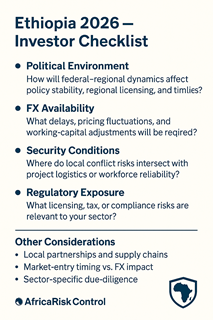
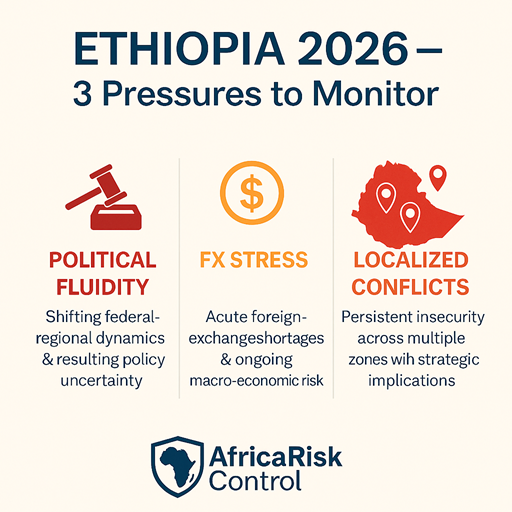 Ethiopia is entering 2026 with a risk environment that is becoming increasingly complex for investors, development partners, and multinational corporations.
  Africa Risk Control (ARC) releases Ethiopia 2026/Q1 Country Risk & Due Diligence Report: A Field-Validated Intelligence Briefing for Investors. Africa Risk Control (ARC) has launched its Ethiopia Country Risk & Due Diligence Report — Premium Edition 2026/Q1, a 107-page intelligence product designed for investors, corporates, lenders, development partners, and due diligence teams navigating Ethiopia’s complex risk landscape.
 By Africa Risk Control (ARC) – Rwanda’s economic transformation over the past two decades has earned the country widespread recognition for discipline, stability, and reform-driven progress. According to the World Bank’s 2025 Rwanda Country Update, the economy is projected to grow between 6% and 7% in 2026, powered by expanding services, construction, tourism recovery, and a national drive toward digital innovation.