
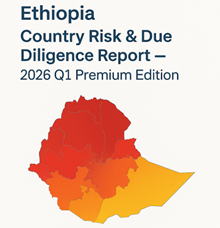
 Africa Risk Control (ARC) releases Ethiopia 2026/Q1 Country Risk & Due Diligence Report: A Field-Validated Intelligence Briefing for Investors. Africa Risk Control (ARC) has launched its Ethiopia Country Risk & Due Diligence Report — Premium Edition 2026/Q1, a 107-page intelligence product designed for investors, corporates, lenders, development partners, and due diligence teams navigating Ethiopia’s complex risk landscape.
Built through ARC’s 32-country investigative journalist network, the report combines human-source intelligence, ground-level data verification, and structured risk scoring to offer one of the most comprehensive assessments available for Ethiopia’s 2026 operating environment.
The report begins with a big-picture assessment of Ethiopia’s political economy, outlining how federal restructuring, coalition dynamics, and regional autonomy debates shape the investment climate. ARC provides new analysis on the Prosperity Party’s internal realignments, diaspora-led pressure campaigns, and the interaction between federal authority and regional administrations.
Security is a major focus. ARC devotes multiple sections to conflict dynamics in Amhara, Oromia, Tigray, Afar, Benishangul-Gumuz, Somali Region, and Gambella. Armed groups, militia coalitions, fragmented command structures, drone capabilities, and escalation triggers are mapped in detail. The report’s mixed-intensity security heat map offers a realistic representation of regional risk variation, accompanied by an indicators table covering political, security, economic, and ESG markers.

Economically, the report highlights Ethiopia’s FX constraints, inflation trajectory, fiscal pressures, and debt environment. The analysis includes 12-month macroeconomic scenarios and provides visibility into the drivers shaping financial stability in 2026. ARC also explains the implications for import-dependent firms, manufacturers, logistics operators, and investors holding medium-term exposure.
The regulatory and legal section examines licensing requirements, FX and repatriation rules, taxation, customs, and the reliability of courts and arbitration systems. ARC identifies high-risk compliance areas and outlines reforms underway across several sectors, including telecom, mining, digital services, and renewable energy.
In the sector-specific chapter, ARC evaluates opportunities and risks in agribusiness, manufacturing, mining, energy, logistics, construction, finance, and tourism. Each sector includes profitability drivers, regulatory barriers, and a 2026 outlook.
One of the report’s key additions is the 2026–2027 medium-term forecast, which presents three probability-weighted scenarios: managed stabilization, prolonged stagnation, and multi-front escalation. ARC interprets what each means for investors, supply chains, operational continuity, and risk-adjusted market entry.
The red-flag due diligence chapter provides a toolset for assessing beneficial ownership, political exposure, land-related risks, licensing irregularities, community dynamics, ESG issues, and reputational exposure. ARC also introduces its Three-Layer Risk Mitigation Model, giving organizations a structured framework for reducing exposure across political, security, regulatory, financial, and operational categories.
The report concludes with ARC’s strategic recommendations for 2026, including sector prioritization, market-entry sequencing, and guidance on governance and ESG positioning.
For organizations preparing to make decisions in Ethiopia in 2026, ARC’s latest publication provides a rare combination of depth, accuracy, and ground-validated intelligence — a critical resource in a fast-shifting environment.
