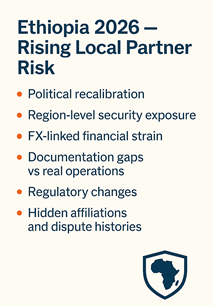
 Two new reports by Africa Risk Control (ARC) have stated that Ethiopia’s 2026 risk environment is now shaped more by district-level developments than national indicators.

Two new reports by Africa Risk Control (ARC) have stated that Ethiopia’s 2026 risk environment is now shaped more by district-level developments than national indicators.
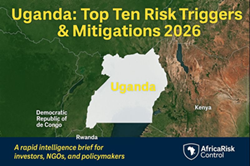 Uganda is entering a decisive phase as the country approaches a national election next month — a period that historically reshapes political behavior, regulatory discretion, security posture, and institutional responsiveness.
 Africa Risk Control (ARC) Investment Risk Analysis – Uganda’s general elections, scheduled for 15 January 2026, arrive at a critical moment for investors assessing East Africa’s medium-term risk outlook. While Uganda remains one of the region’s more resilient investment destinations, election cycles have historically introduced short-term volatility that can materially affect policy execution, regulatory behavior, and operational continuity.
Africa Risk Control (ARC) has released new insights into how sector opportunities in Ethiopia are shifting due to political, economic, and security pressures. The organization reports that while long-term potential remains strong, sectors face differing levels of exposure as the country moves toward 2026.
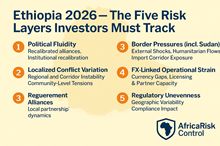 Africa Risk Control (ARC) has identified growing concerns around governance inconsistency and district-level tensions that could influence Ethiopia’s 2026 investment landscape.
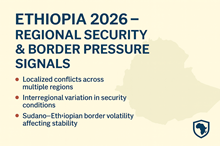 Africa Risk Control (ARC) in its new report stated that corridor stability and local mobility will be decisive factors for Ethiopia’s investment environment in 2026. The organization’s assessments highlight how short-term disruptions continue to affect key transport routes.
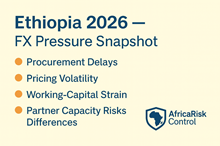 Africa Risk Control (ARC) has issued a warning that Ethiopia’s persistent foreign-exchange shortages will remain one of the most important business risks in 2026. The organization notes that FX pressure affects not only imports but also partner behavior, procurement cycles, and broader operational performance.
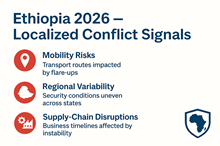 Africa Risk Control (ARC) has highlighted increasing conflict-linked pressures that could influence Ethiopia’s operating landscape heading into 2026. While national stability indicators suggest gradual improvement, ARC’s field intelligence shows that several regions continue to face intermittent tensions.
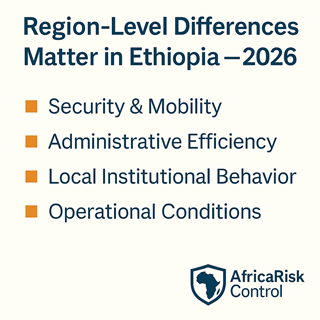 Africa Risk Control (ARC) has emphasized that regional variation will be a determining factor for investment feasibility in Ethiopia during 2026. The organization states that national-level indicators fail to capture the operational, administrative, and security differences that exist between districts.
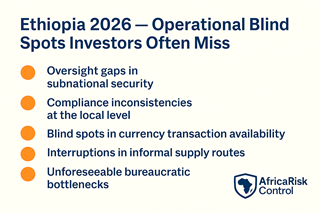 As Ethiopia enters 2026, operational risks are becoming increasingly complex and uneven across regions. Africa Risk Control’s (ARC) field-level intelligence shows that many investors and multinational operators overlook critical on-the-ground blind spots during due-diligence and project planning stages. These gaps often result in delays, increased costs, misaligned partnerships, and—more importantly—incorrect assumptions about operational feasibility.