
 In Chad, elections resolve legal status—but they do not settle legitimacy. President Mahamat Déby’s grip on power entering 2026 is firm, anchored in military cohesion and elite alignment. Near-term regime collapse is unlikely. Yet this stability rests on a narrow base, prioritizing security control over institutional consolidation.
The consequence is a political environment where authority is centralized, but governance is fragmented. Opposition weakness reflects constraint rather than acceptance, increasing the likelihood that grievances surface through unstructured channels such as protests, labor action, or localized unrest.
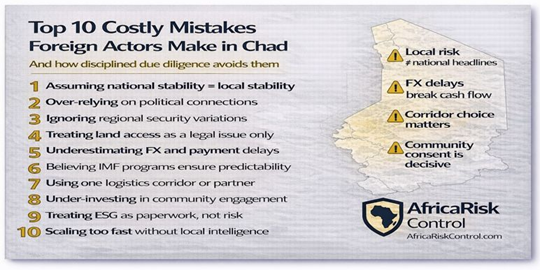
ARC’s Chad 2026: Top 10 Due Diligence & Risk Advisories Decision-Makers Need report treats political risk as an administrative and operational variable, not an electoral one. The most consequential exposure arises where enforcement is discretionary, approvals are personalized, and local power dynamics override formal rules.
For decision-makers, this means political continuity does not equal predictability. Stability at the center can coexist with volatility at the edges—and it is the edges where projects most often fail.
The Chad 2026 report provides decision-grade insight into how power is exercised, not just who holds it.