
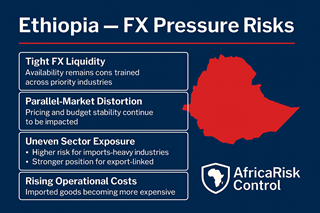
 Foreign-exchange pressure has become one of the most decisive macroeconomic variables shaping Ethiopia’s investment climate heading into 2026. While the country’s long-term fundamentals remain compelling, FX constraints continue to influence pricing, working capital, procurement cycles, and overall cost structures across multiple sectors. Today’s ARC Intelligence Insight explores why FX conditions remain a central consideration for investors and operational teams preparing for 2026.
Ethiopia’s FX landscape is currently shaped by structural imbalances, import dependencies, and broader liquidity pressures. Even as policy reforms continue, foreign-currency availability remains tight, creating delays and uncertainty for companies reliant on imported goods, machinery, or foreign-denominated transactions. ARC’s field reporting shows that businesses across manufacturing, logistics, construction, and agribusiness face challenges in accessing the FX required for operational continuity.

One of the core issues is the unpredictability in FX allocation. Although priority sectors receive attention, real-world access varies across institutions and timelines. For firms operating in time-sensitive sectors, this creates vulnerabilities in supply-chain planning. Delays in acquiring raw materials or spare parts can disrupt production cycles and have downstream effects on revenue and market commitments.
FX constraints also influence broader economic activity. As imported goods become more expensive, operational costs rise, and businesses are forced to adjust pricing strategies. Firms with narrow margins or high import-dependency face heightened exposure. This dynamic poses particular challenges for new market entrants who may underestimate the practical impact of FX delays on startup timelines and capital requirements.
ARC’s Ethiopia Country Risk & Due Diligence Report — 2026 Q1 Premium Edition provides deeper insight into these issues. The report outlines macroeconomic pressure points, liquidity outlooks for 2026, sector exposure profiles, and scenarios for FX availability over the next 12 months. Investors analyzing market-entry plans, financing models, or regional expansions benefit from these diagnostics before committing capital.
Despite these challenges, opportunities remain for well-prepared organizations. Sectors aligned with export earnings, digital services, or lower import-dependency demonstrate greater resilience. Companies that adopt diversified sourcing, phased procurement strategies, and risk-adjusted FX models are better positioned to navigate volatility.
The FX landscape is unlikely to resolve quickly, making forward planning essential. ARC continues to monitor FX developments across agencies, banks, and regional markets to support investor clarity and operational decision-making.