
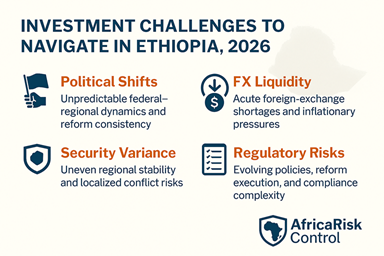
 Ethiopia’s 2026 investment outlook will be significantly influenced by region-level variations in governance, security, and operational conditions, according to new analysis published by Africa Risk Control (ARC). The firm’s latest assessment highlights how differences across regions are expected to shape business performance, partnership reliability, and project implementation in the coming year.
ARC’s analysts note that Ethiopia’s national economic strategy continues to evolve, but the reality on the ground differs across local jurisdictions. In some regions, administrative processes function predictably, while others experience variations in regulatory enforcement, licensing behavior, and institutional coordination. For investors planning market-entry or expansion, these discrepancies can affect timelines and operational planning.
Security remains a major factor shaping 2026 prospects. ARC’s field findings show that localized disturbances, mobility restrictions, and periodic clashes continue to affect certain districts, even as other areas remain stable. These micro-level variations influence logistics flows, workforce mobility, and supply-chain reliability — key considerations for manufacturing, agribusiness, transport, and construction.
Economic exposure also differs by region. Some areas benefit from stable market linkages and strong local demand, while others face recurring disruptions linked to transport routes, informal checkpoints, or security operations. ARC notes that such conditions can directly influence business costs and project feasibility.
Foreign-exchange constraints, though national, affect sectors differently based on regional supply-chain dynamics. Companies that rely on imported materials face varying procurement delays depending on their operational footprint.
ARC’s analysis concludes that Ethiopia’s investment environment cannot be assessed solely through a national lens. The firm recommends that investors apply region-specific due diligence frameworks to better evaluate political sensitivities, regulatory reliability, and security dynamics.
ARC’s Ethiopia Country Risk & Due Diligence Report — 2026 Q1 Premium Edition provides detailed region-level mapping, sector-specific analysis, and vulnerability assessments for investors planning to operate in Ethiopia in 2026.
Book to consultations to learn more about Africa Risk Control’s enhanced due diligence & risk advisory services across African countries.