
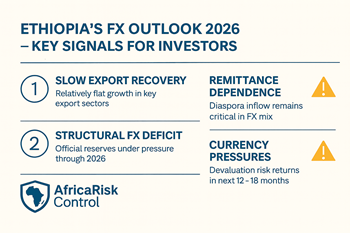
 Foreign-exchange pressure remains one of the most defining macroeconomic realities shaping Ethiopia’s investment environment as the country moves toward 2026. Africa Risk Control’s (ARC) latest analysis shows that FX constraints continue to influence operational feasibility, project timing, supply-chain stability, and overall cost structures across multiple sectors. For investors preparing long-term strategies or evaluating market-entry decisions, understanding Ethiopia’s FX trajectory is essential.
Ethiopia, like several frontier markets, is managing a prolonged FX shortage driven by external imbalances, import dependencies, structural bottlenecks, and currency pressures. Despite renewed reform commitments, liquidity remains tight and access varies significantly by sector, company profile, and strategic priority. ARC’s field-based assessments indicate that even well-established firms face delays in accessing foreign currency, complicating procurement cycles and financial planning.
One of the major concerns raised by investors is the unpredictability surrounding FX allocation. While official guidance aims to prioritize productive and strategic sectors, the practical distribution of forex can be uneven. Companies reliant on imported raw materials, spare parts, or capital goods often face long waiting times, forcing them to adjust project timelines, renegotiate supplier terms, or seek alternative financing strategies.
Parallel market activity further complicates the landscape. Although the government continues efforts to manage pricing distortions, the gap between the official and parallel market rates remains a challenge for operators that must reconcile planned budgets with real-time market realities. These dynamics increase exposure for businesses with thin margins or high import dependency.
ARC’s analysis also shows that FX pressure spills into broader economic activity. Price adjustments on imported goods translate into higher operational costs, affecting everything from logistics to production. Firms working in sectors that require steady replenishment of inputs — such as manufacturing, construction, agribusiness, and automotive services — should factor these pressures into their 2026 planning assumptions.
Yet opportunities remain. Sectors benefiting from export capacity, foreign financing channels, or digital-service models face relatively less FX exposure. Firms that integrate risk-adjusted planning, diversified sourcing, and forward-looking due-diligence processes are better positioned to manage volatility.
ARC’s Ethiopia Country Risk & Due Diligence Report — 2026 Q1 Premium Edition provides detailed FX diagnostics, macroeconomic scenario modelling, and sector-level exposure assessments to support investors, donors, and corporate operators in navigating this environment.
Request the Executive Summary: [email protected]
Buy the full Premium Report
Book a 20-minute consultation to discuss your due-diligence and intelligence needs
 Ethiopia Country Risk & Due Diligence Report
2026 Q1 Premium Edition
A 107-page intelligence report covering political, FX, security, conflict, regional vulnerabilities, and sector-specific risks.