
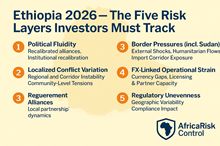
 Africa Risk Control (ARC) has identified growing concerns around governance inconsistency and district-level tensions that could influence Ethiopia’s 2026 investment landscape.
According to ARC’s latest analysis, administrative behavior and local political dynamics continue to vary by region, shaping how reforms are implemented and how investors navigate regulatory processes.
ARC reports that while federal government policy aims to improve the ease of doing business, regional differences persist in licensing, enforcement, and tax administration. These variations affect investment timelines and operational predictability, especially in sectors requiring land access or regulatory approvals.

Security conditions remain uneven across the country. ARC’s field assessments show sporadic clashes, community tensions, and mobility restrictions in several districts. These localized incidents have implications for transport routes, staff movement, and supply-chain reliability.
Foreign-exchange shortages add another layer of risk. ARC notes that FX pressure will continue to influence procurement cycles and working-capital planning, particularly for companies dependent on imported inputs or foreign financing.
The organization says Ethiopia’s 2026 environment requires closer monitoring of regional dynamics, stronger due-diligence processes, and updated risk assessments tailored to sector exposure.
Africa Risk Control’s Ethiopia Micro Risk Brief Q1/2026 provides deeper political scenarios, region-level mapping, FX diagnostics, regulatory exposure, and due-diligence guidance.
Request free Summary: [email protected]
Get Ethiopia Micro Risk Brief Q1/2026
You can also book Supplementary Intelligence Briefing call.
Ethiopia Country Risk Profile 2026 is also Now Available.
To Learn More About Africa Risk Control’s Services, Book A 20-Minute Free Consultation.