
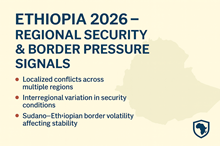
 Africa Risk Control (ARC) in its new report stated that corridor stability and local mobility will be decisive factors for Ethiopia’s investment environment in 2026. The organization’s assessments highlight how short-term disruptions continue to affect key transport routes.
ARC’s field sources report that several strategic corridors experience periodic interruptions due to security operations, community tensions, or administrative inconsistencies at checkpoints. These disruptions have direct implications for logistics, agribusiness, manufacturing, and humanitarian operations.
The organization also notes that border-area pressures linked to Sudan may influence mobility patterns in western Ethiopia, affecting the movement of goods and cross-regional trade. ARC warns that companies relying on stable corridor performance without monitoring district-level dynamics may face unexpected delays or cost increases.

Border dynamics are becoming equally significant. The war in Sudan continues to shape security pressures along Ethiopia’s northwestern frontier, influencing displacement patterns, informal trade flows, and the stability of adjacent districts. These pressures affect humanitarian access, transport routes, and commercial movement across border-linked corridors. ARC’s assessments suggest that these dynamics will continue into 2026, requiring investors to incorporate cross-border considerations into their due-diligence frameworks.
At the same time, political recalibration between federal and regional authorities continues to influence administrative consistency. This affects licensing, compliance, sector approvals, and local partner reliability. Investors relying on outdated assumptions about political influence or institutional behavior may misjudge timelines or exposure.
Sector-level risks also differ
• Agribusiness faces exposure to corridor disruptions and community tensions near production zones.
• Energy and infrastructure projects must navigate land access dynamics and localized political sensitivities.
• Mining is affected by regional disputes, informal activity, and security unpredictability.
• Logistics and transport depend heavily on corridor-level stability, which varies month to month.
The organization advises that supply-chain planning for 2026 must incorporate contingency routes, regional scenario mapping, and partner verification to ensure continuity.
Africa Risk Control’s Ethiopia 2026 Premium Report provides deeper political scenarios, region-level mapping, FX diagnostics, regulatory exposure, and due-diligence guidance.
Get the full premium Africa Risk Control’s report here with one hour intelligence briefing call with our country desk chief: https://lnkd.in/dzcKmfTA
Request free Summary: [email protected]
Get Ethiopia Micro Risk Brief Q1/2026
You can also book Supplementary Intelligence Briefing call here
Ethiopia Country Risk Profile 2026 is also Now Available.
To Learn More About Africa Risk Control’s Services, Book A 20-Minute Free Consultation Here.