
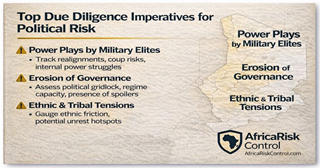
 Chad is often misread through the wrong lens. Market size metrics understate its importance, while strategic risk exposure is routinely underestimated.
As Chad enters the 2026 horizon, its relevance is defined by consequence rather than scale. This is according to Africa risk Control’s (ARC) new report, Chad 2026: Top 10 Due Diligence & Risk Advisories Decision-Makers Need. The country anchors security architecture across the Sahel–Central Africa corridor, absorbs regional conflict spillovers, and hosts state-linked and external actors whose interests extend far beyond Chad’s borders.
Political continuity following the 2024 elections has reduced regime-collapse risk, but it has not normalized governance. Power remains concentrated within security and elite networks, producing an operating environment where formal rules exist, but discretion dominates execution. For decision-makers, this distinction is critical.
Economically, oil dependence and fiscal pressure create predictable—but cumulative—operational stress. Payment delays, enforcement surges, and FX bottlenecks tend to appear not as shocks, but as structural features that intensify during pressure cycles.
Security risk further reinforces Chad’s high-consequence profile. Risk is geographic, corridor-specific, and sensitive to regional developments—particularly along northern and eastern borders. Projects fail not because Chad is uniformly unstable, but because exposure is misread as uniform.
ARC’s Chad 2026 report was developed to help decision-makers recalibrate how they assess Chad. It moves beyond abstract indicators and focuses on where risk concentrates, how failures occur in practice, and why disciplined operators succeed.
This report is designed for organizations that understand that in Chad, preparation is not optional—it is the entry cost.