
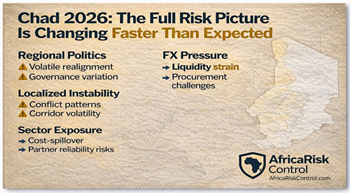
In reality, Chad is a high-consequence environment where outcomes are determined less by strategy documents and more by execution discipline. Political continuity under President Mahamat Idriss Déby reduces near-term regime risk, but it does not eliminate operational volatility. Risk has shifted downward—into administrative behavior, corridor security, elite-driven enforcement, and local power dynamics that are invisible in national-level assessments.
This is where most due diligence fails.
Organizations frequently underestimate how security geography shapes feasibility, how IMF-linked fiscal pressure alters enforcement behavior, how land access depends on consent rather than concession, and how FX and payment risk manifests as delay rather than prohibition. ESG exposure is rarely driven by intent, but by association—security forces, partners, land disputes, and proximity to humanitarian stress.
These are not theoretical risks. They are repeat failure points.
Africa Risk Control’s “Chad 2026: Top 10 Due Diligence & Risk Advisories Decision-Makers Need” was developed to address this gap. The report does not attempt to predict elections or model abstract instability. Instead, it focuses on the ten operational blind spots that consistently undermine otherwise viable projects—often within the first 12–18 months of entry.
Each advisory is designed to answer the questions decision-makers ask after problems emerge:
Why did enforcement change suddenly?
Why did land access collapse despite legal approval?
Why did payments stall?
Why did reputational exposure escalate so quickly?
ARC’s analysis is grounded in field intelligence, regional security mapping, and practical execution experience. It is intended for decision-makers who require early-warning clarity, not post-failure explanations.
For organizations with real exposure to Chad—financial, operational, or reputational—this report serves as a risk filter before commitments are made.
Access the full 18-page ARC intelligence report here:
In addition, you can book a one hour intelligence briefing call with ARC Country Lead Researcher for Chad to further discuss the findings of the report and related issues.