
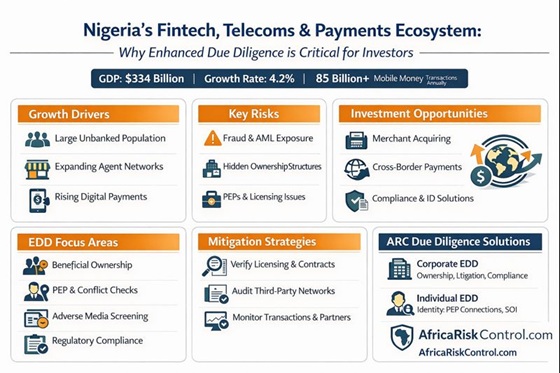
 Nigeria’s fintech and digital payments sector has become one of Africa’s most visible investment stories, not because it is fashionable, but because it addresses a structural gap in the economy.
In a market where large segments of the population remain underserved by traditional banking, digital platforms have become essential infrastructure for commerce, remittances, payroll, merchant payments, and financial access.
For foreign investors, strategic partners, and regional acquirers, Nigeria offers scale that few African markets can match. At the same time, the very characteristics that make the sector attractive—rapid growth, dense third-party networks, and regulatory evolution—also make it one of the most due-diligence-intensive operating environments on the continent.
This combination of opportunity and complexity means that success in Nigeria’s fintech and telecom-adjacent ecosystem is determined less by market entry than by governance, counterparty integrity, and execution discipline.
Macro Context and Investment Environment
Nigeria remains one of Africa’s largest economies by nominal GDP and population, making it a natural anchor for digital financial services. Recent macroeconomic adjustments, including exchange-rate reforms and monetary tightening, have reshaped operating conditions for consumer-facing platforms. These shifts affect transaction volumes, credit performance, liquidity management, and the cost of capital—factors that directly influence fintech business models.
From an investment perspective, macro volatility does not negate opportunity, but it amplifies risk differentiation. Platforms with strong controls, diversified revenue streams, and disciplined governance tend to withstand shocks better than those built on aggressive growth assumptions and weak compliance foundations.
Sector Structure and Why It Matters
Nigeria’s fintech and payments ecosystem is not a single market but an interconnected system. Telecom infrastructure underpins mobile access; agent networks extend services into semi-urban and rural areas; payment processors handle high-volume transactions; and fintech overlays provide wallets, merchant acquiring, lending, and cross-border functionality.
This layered structure creates multiple entry points for investors—ranging from equity participation and acquisitions to strategic partnerships and vendor onboarding. It also creates multiple points of failure. Weakness in one layer, such as agent oversight or licensing compliance, can cascade through the system and disrupt operations, partnerships, or regulatory standing.
Understanding how these layers interact is essential for any serious investor evaluating exposure in Nigeria.
Five-Year Performance: Growth, Correction, and Consolidation
Over the past five years, Nigeria’s digital payments sector has experienced a clear cycle. Initial acceleration was driven by rapid user adoption, expanding agent networks, and increasing comfort with mobile transactions. This phase attracted significant capital and produced several high-profile platforms.
The subsequent period exposed structural weaknesses. Funding conditions tightened, regulatory scrutiny increased, and macroeconomic pressures tested business resilience. Platforms with weak governance, unclear ownership structures, or poorly controlled third-party networks struggled to adapt.
The current phase is characterized by consolidation and institutionalization. Regulators expect stronger compliance. Banks and multinational partners demand higher assurance. Investors are more selective, prioritizing transparency, risk management, and sustainability over raw user growth.
This evolution is not a slowdown; it is a maturation process that rewards disciplined operators and penalizes opaque ones.
Where Investors Find Real Opportunity
The most credible opportunities in Nigeria’s fintech ecosystem today are linked to real economic activity rather than speculative expansion. Merchant payments, payroll solutions, agency banking, and infrastructure-level services that support compliance, identity verification, and transaction monitoring remain attractive.
Cross-border payments and regional trade facilitation also offer upside, particularly as intra-African commerce expands. However, these opportunities carry heightened regulatory and sanctions exposure, making governance and compliance non-negotiable.
In all cases, value creation depends on trust—by users, regulators, partners, and correspondent institutions.
The Hidden Risks That Undermine Deals
In ARC’s experience, most failed or impaired fintech investments in Nigeria do not collapse because the market opportunity disappears. They fail because risks were misunderstood, underestimated, or discovered too late.
Common issues include opaque beneficial ownership structures, undisclosed politically exposed person (PEP) connections, overstated licensing claims, unmanaged agent or aggregator networks, unresolved litigation, and adverse media that surfaces during scale-up or partnership negotiations.
These risks are rarely visible in pitch decks or early-stage discussions. They emerge during regulatory reviews, bank partnerships, acquisitions, or cross-border expansion—precisely when the cost of failure is highest.
Why Enhanced Due Diligence Is Decisive in Nigeria
Standard commercial due diligence is insufficient in Nigeria’s fintech and telecom-adjacent sectors. The density of third parties, the importance of regulatory alignment, and the reputational sensitivity of financial services require Enhanced Due Diligence (EDD) that goes beyond surface-level checks.
For investors and partners, EDD answers critical questions: Who ultimately controls the entity? Are there hidden interests or conflicts of interest? Are key executives, agents, or intermediaries politically exposed? Does the company’s operational reality match its regulatory positioning? Are there material integrity or reputational risks embedded in its network?
Without clear answers to these questions, even well-structured investments can become exposed to enforcement action, partnership breakdowns, or reputational damage.
ARC’s Due Diligence Approach
Africa Risk Control supports Nigeria-focused transactions through two complementary services.
Corporate Enhanced Due Diligence examines beneficial ownership and control, related-party relationships, litigation and regulatory standing, sanctions and adverse media exposure, financial red flags, and governance integrity across the organization and its critical third parties.
Individual Enhanced Due Diligence focuses on founders, executives, major shareholders, politically exposed persons, and key intermediaries, assessing identity, background, conflicts of interest, source-of-wealth indicators, and reputation risk.
Together, these services enable clients to engage Nigeria’s fintech and payments ecosystem with clarity, confidence, and defensible risk positioning.
Scale Rewards the Prepared
Nigeria’s fintech, telecoms, and payments sector will continue to grow because it solves real economic problems at national scale. But scale alone does not protect capital. In this market, the difference between success and failure is rarely technology—it is governance, transparency, and integrity.
For investors, acquirers, and strategic partners, Enhanced Due Diligence is not a regulatory burden. It is a competitive advantage.
If you are evaluating a fintech, payments platform, telecom-adjacent service provider, key executive, or strategic partner in Nigeria, ARC can support you with:
Corporate Enhanced Due Diligence (EDD) – Beneficial ownership verification, litigation and regulatory checks, sanctions and adverse media screening, third-party integrity review, and governance risk assessment.
Individual Enhanced Due Diligence (EDD) – Identity and background verification, Politically Exposed Person (PEP) and conflict-of-interest mapping, source-of-wealth red-flag review, and reputation risk profiling.