
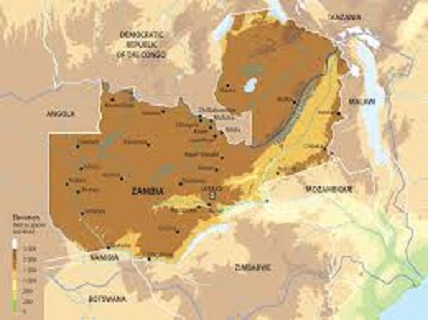
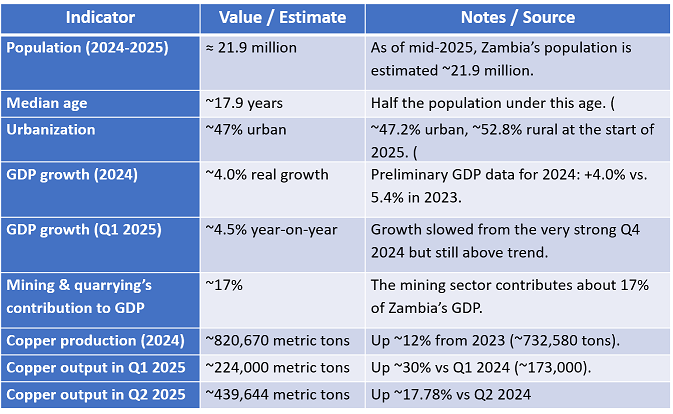
 By Africa Risk Control Southern Africa Desk – Zambia, a landlocked country in Southern Africa with a population of about 20.3 million (2024), is positioning itself as a leading investment destination in the region.
The economy has shown resilience, recording a GDP of approximately USD 31 billion with growth rebounding to around 3.5–4% annually in recent years. Known globally as Africa’s second-largest copper producer, Zambia continues to attract global interest in mining, while infrastructure development remains central to unlocking its broader economic potential.
For investors, the convergence of mineral wealth, policy reforms, and strategic location makes Zambia an attractive destination for long-term capital deployment.
Key Investment Opportunities
1. Mining and Minerals Processing
Mining contributes nearly 18–20% of Zambia’s GDP and accounts for about 70% of export earnings. Copper remains the dominant mineral, with production exceeding 760,000 metric tonnes in 2023, and the government targeting 1.3 million tonnes annually by 2030.
Beyond copper, opportunities exist in cobalt, gold, manganese, and gemstones. The government has introduced incentives for downstream processing, encouraging investment in smelters, refineries, and local value addition. This creates openings for foreign investors to partner in beneficiation and diversify revenue streams.
2. Energy and Power Infrastructure
Zambia’s economic growth is constrained by power shortages, despite having an estimated 6,000 MW hydropower potential, of which only 3,500 MW is currently installed capacity. Load shedding affects mining and industry, creating opportunities in renewable energy projects — particularly solar, wind, and small hydro.
Foreign investors are increasingly being courted through Independent Power Producer (IPP) frameworks, with room to develop off-grid and captive power solutions to serve large-scale mining operations and industrial clusters.
3. Transport and Logistics
Zambia’s strategic location — bordering eight countries — positions it as a natural trade hub. However, infrastructure gaps persist. Rail corridors such as the Tazara Railway (linking to Tanzania’s Dar es Salaam Port) and North-South Corridor (to South Africa) need upgrades and modernization.
Investment opportunities exist in:
– Modernizing railway lines to improve mineral exports.
– Expanding road networks for regional trade.
– Upgrading border facilities to reduce transit delays.
– Developing dry ports and logistics parks in Lusaka, Ndola, and near mining hubs.
4. Construction and Urban Development
Zambia’s urban population is growing at 4% annually, creating housing and infrastructure demands. The construction sector, valued at around USD 1.5 billion, is expanding through public-private partnerships (PPPs) in roads, bridges, water systems, and affordable housing projects. Investors can tap into government-backed PPP frameworks and donor-supported infrastructure initiatives.
Risks & Challenges
Despite its opportunities, Zambia presents risks that investors must navigate carefully:
Debt burden: The country has undergone debt restructuring, but external debt remains a fiscal challenge.
Currency volatility: The Zambian kwacha is sensitive to copper price fluctuations.
Energy reliability: Power shortages can disrupt industrial output.
Policy uncertainty: Mining tax regimes have shifted in the past, creating investor unease.
Logistics bottlenecks: Inefficient border and transport systems can increase operational costs.
Risk Mitigation Strategies
To minimize risks, investors should:
– Conduct independent due diligence on regulatory and fiscal frameworks.
– Build currency hedging strategies to protect returns.
– Diversify across mining, energy, and infrastructure projects rather than focusing on a single sector.
– Engage in stakeholder mapping and community engagement to secure social license.
– Work with local investigative and business intelligence partners to assess counterparties and mitigate fraud risks.
In summary, Zambia’s mix of mineral wealth, strategic geography, and infrastructure ambitions presents high-potential opportunities for forward-looking investors. While challenges remain, proactive due diligence, strong local partnerships, and risk-aware investment strategies can unlock significant value in the mining, energy, and logistics sectors.
Africa Risk Control’s Southern Africa Desk provides on-the-ground due diligence, risk advisory, and partnership facilitation across Zambia and the wider region.
If you are considering an investment in Zambia’s mining, infrastructure, energy, or logistics sectors, our team can:
– Deliver independent due diligence reports tailored to your project.
– Identify credible local partners and validate their track record.
– Provide regulatory and political risk assessments.
– Support with stakeholder mapping and community engagement strategies.
Contact our Southern Africa Desk today to explore how we can support your investment or partnership initiatives in Zambia.