
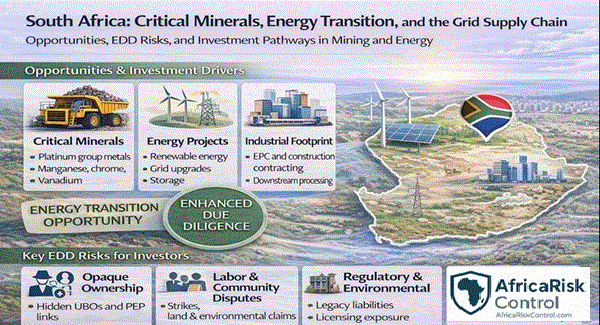
 South Africa remains one of Africa’s most strategically important investment destinations, driven by its role in critical minerals supply, industrial capacity, and regional energy infrastructure. Platinum group metals, manganese, chrome, and vanadium position the country at the center of global energy transition value chains.
At the same time, chronic electricity shortages, regulatory complexity, and heightened ESG scrutiny have reshaped how investors evaluate counterparties. In this environment, Enhanced Due Diligence (EDD) is no longer a compliance formality but a commercial necessity for managing operational, reputational, and continuity risk.
Macro and Investment Context
South Africa is Africa’s most industrialized economy, with deep capital markets and globally integrated mining and manufacturing sectors. Despite modest GDP growth in recent years, South Africa continues to attract significant investment interest due to its resource base and infrastructure footprint.
Over the past five years, macro performance has been constrained by energy supply disruptions, logistics bottlenecks, and fiscal pressure. Power shortages alone have shaved multiple percentage points off potential growth. In response, reforms have accelerated in electricity generation, private power procurement, and grid modernization—opening new entry points for investors, EPC contractors, equipment suppliers, and financiers.
Sector Overview: Critical Minerals and Energy Value Chains
South Africa’s mining sector underpins its global relevance. Platinum group metals support hydrogen, fuel cells, and automotive catalysts. Manganese and chrome are essential to battery storage and steelmaking. These minerals feed downstream processing, transport, and export ecosystems that extend well beyond mine sites.
Parallel to mining, the energy transition has reshaped demand across the grid value chain. Grid expansion, transmission upgrades, embedded generation, and renewable integration have created opportunities for engineering firms, equipment vendors, financiers, and service providers. However, these opportunities sit within complex regulatory and institutional frameworks.
Performance Over the Last Five Years
Between 2019 and 2024, mining output has been volatile, affected by labor disputes, infrastructure constraints, and power instability. At the same time, export demand for critical minerals remained resilient, driven by global decarbonization strategies.
Energy-sector investment gained momentum as licensing thresholds were raised, allowing private generation projects to proceed without lengthy approvals. This unlocked a pipeline of solar, wind, and hybrid projects—but also expanded the ecosystem of contractors, agents, and intermediaries seeking to participate.
Deal Landscape and Entry Pathways
Foreign investors typically enter through:
• Joint ventures with local mining or energy firms
• Vendor and supplier contracts within EPC frameworks
• Acquisition of minority stakes in operating assets
• Service agreements tied to grid upgrades or energy projects
Where deals fail is rarely at the headline level. Failure usually emerges through misaligned partners, opaque ownership structures, labor exposure, or unresolved environmental liabilities.
Key Stakeholders and Risk Nodes
South Africa’s regulatory and operational environment involves multiple actors: sector regulators, state-owned entities, provincial authorities, labor unions, and community structures. Each represents a potential risk node if not properly understood.
High-risk areas commonly include:
• Beneficial ownership hidden behind layered holding structures
• Politically exposed persons (PEPs) linked to procurement pathways
• Legacy environmental and rehabilitation liabilities
• Labor and community disputes that escalate into litigation
EDD Risk Map: What Investors Must Verify
In South Africa’s mining and energy-linked sectors, EDD typically focuses on:
• Ownership and control: Identifying ultimate beneficial owners across complex corporate chains
• Regulatory standing: Verifying licenses, permits, and compliance history
• Litigation exposure: Labor disputes, environmental claims, and contractual arbitration
• ESG alignment: Community engagement, land access, and social license to operate
• Sanctions and adverse media: Especially for counterparties with cross-border exposure
ARC’s Due Diligence Approach
Individual EDD examines executive and shareholder backgrounds, PEP exposure, conflicts of interest, source-of-wealth indicators, and reputation risk.
Corporate EDD maps ownership, affiliates, litigation history, regulatory compliance, financial red flags, and operational credibility, including site-level verification where required.
Risk Mitigation in Practice
Effective mitigation combines:
• Pre-contract verification
• Clear representations and warranties
• Ongoing monitoring for leadership or ownership changes
• Early-warning indicators tied to labor unrest or regulatory shifts
If you are evaluating a partner, acquisition, executive, or key supplier in South Africa’s critical minerals or energy value chain, ARC provides Corporate and Individual Enhanced Due Diligence tailored to high-risk, compliance-sensitive environments.