
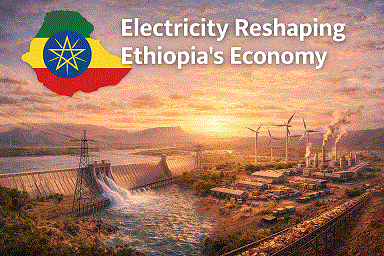
 Ethiopia is often approached as a frontier market, yet its defining characteristic is not fragility but scale. With a population exceeding 120 million and one of Africa’s largest domestic markets, the country’s economic strategy has long focused on industrialization rather than resource export dependence.
Month: February 2026
Morocco’s Industrial Bet: Inside Africa’s Emerging Automotive and Aerospace Powerhouse
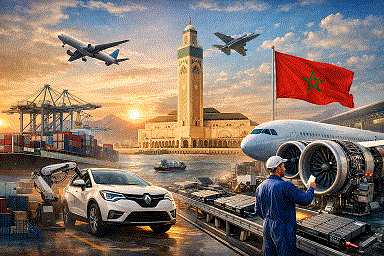 For two decades, Morocco was viewed mainly as a gateway to tourism, agriculture, and phosphate exports. Today, it is becoming something else entirely — a strategic manufacturing platform embedded inside European supply chains while geographically anchored in Africa.
Integrity and ESG Risk in Mozambique Accumulates Quietly
 Integrity and Environmental, Social, and Governance (ESG) risk in Mozambique is predictable, concentrated, and frequently indirect. ARC’s analysis shows that exposure rarely arises from overt demands; instead, it accumulates through routine operational interfaces—customs, ports, licensing, procurement, and engagement with state-linked entities.
Safeguarding Capital: Navigating Kenya’s 2026 High-Growth Investment Frontiers
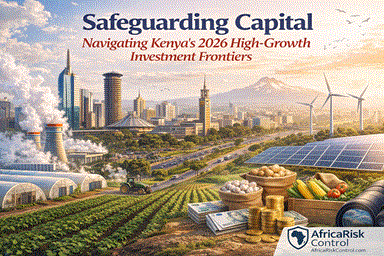 As the first quarter of 2026 unfolds, Kenya has transitioned from a story of “emerging potential” into a sophisticated, multi-layered marketplace that serves as the undisputed economic engine of the 400-million-person East African Community.
South Africa’s Critical Minerals, Energy Transition, and Grid Supply Chain
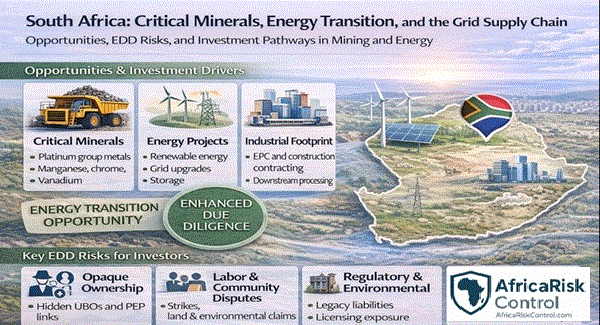 South Africa remains one of Africa’s most strategically important investment destinations, driven by its role in critical minerals supply, industrial capacity, and regional energy infrastructure. Platinum group metals, manganese, chrome, and vanadium position the country at the center of global energy transition value chains.