
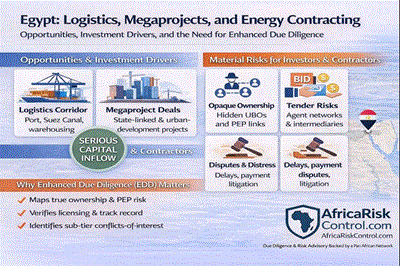
Month: January 2026
Land in Chad Is Accessed Once, but Secured Continuously
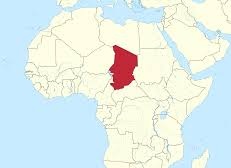 Formal land documentation in Chad does not guarantee operational continuity. Africa Risk Control’s Chad 2026 report treats land risk as a relationship-management challenge rather than a legal one.
Nigeria’s Fintech: Opportunities, Risk, and Why Enhanced Due Diligence Determines Outcomes
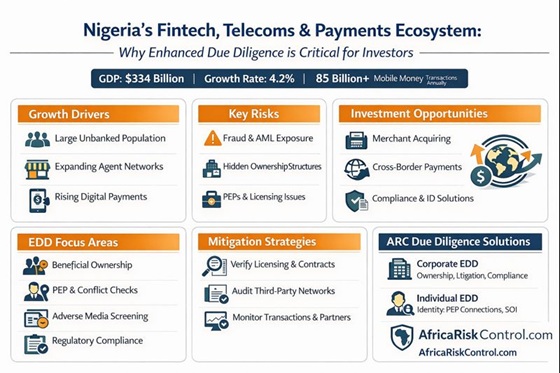 Nigeria’s fintech and digital payments sector has become one of Africa’s most visible investment stories, not because it is fashionable, but because it addresses a structural gap in the economy.
Why Reassessing Political, FX, and Security Assumptions in Ethiopia Vital
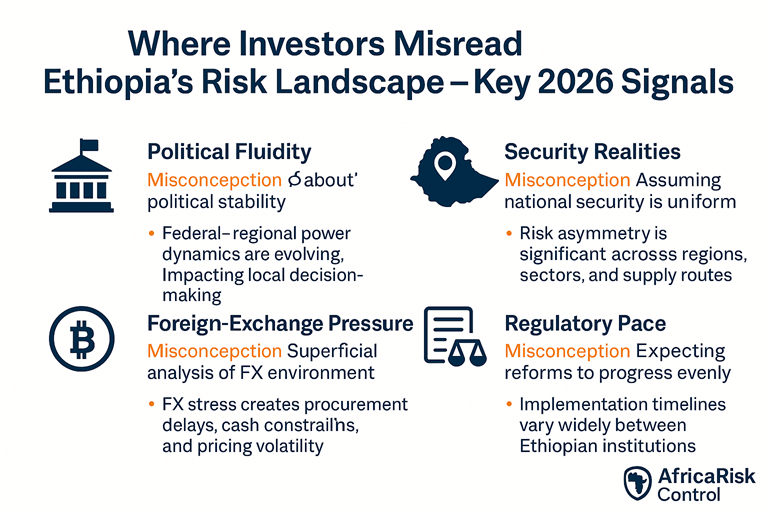 Africa Risk Control (ARC) Ethiopia report states that investors preparing for Ethiopia’s 2026 transition must re-evaluate assumptions regarding political stability, foreign-exchange availability, and security conditions. The firm’s recent findings indicate that several key indicators are shifting more rapidly than expected.
Why Bureaucratic Risk in Mozambique Is About Alignment, Not Rules
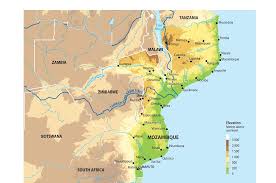 Mozambique’s regulatory environment is often described as slow or opaque. ARC’s assessment suggests a more precise diagnosis: bureaucratic risk is driven by misalignment, not lack of rules.
Corruption in Chad Is Rarely a Shock: It Is a Slow Burn
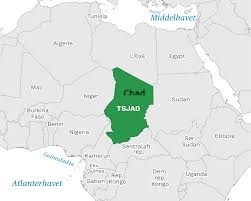 Most corruption-related failures in Chad do not result from a single incident. They emerge through repetition.
Local Partner Due Diligence Critical for Ethiopia’s 2026 Investment Environment
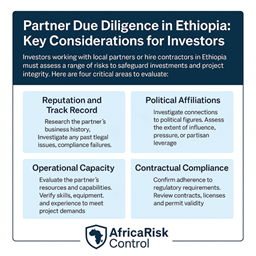 Local partner selection is expected to play a decisive role in Ethiopia’s 2026 investment climate, according to new analysis from Africa Risk Control (ARC). The firm warns that governance gaps, political exposure, and operational inconsistencies may pose increased risks for investors who rely solely on documentation when evaluating partners.
Operational Risk Is Where Political, Regulatory, and Financial Pressures Converge
 Operational disruption is rarely caused by a single factor. In Uganda, it often emerges when political timing, regulatory behavior, security conditions, and financial constraints intersect.
Region-Level Differences to Shape Ethiopia’s 2026 Investment Climate
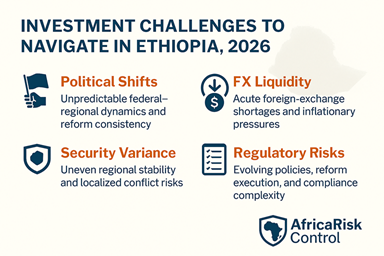 Ethiopia’s 2026 investment outlook will be significantly influenced by region-level variations in governance, security, and operational conditions, according to new analysis published by Africa Risk Control (ARC). The firm’s latest assessment highlights how differences across regions are expected to shape business performance, partnership reliability, and project implementation in the coming year.
IMF Programs in Chad Stabilize Policy, Not Ground-Level Behavior
 IMF engagement in Chad provides macro direction, but it does not eliminate operational volatility. Africa risk Control’s Chad 2026 report treats fiscal pressure as a behavioral risk driver. Under revenue stress, enforcement intensity often increases selectively, affecting customs, taxation, subsidies, and payment timelines.