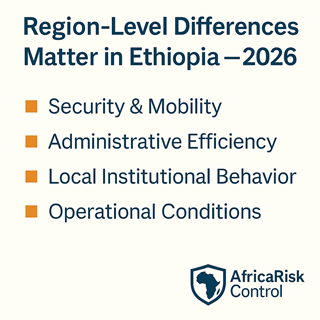
 Africa Risk Control (ARC) has emphasized that regional variation will be a determining factor for investment feasibility in Ethiopia during 2026. The organization states that national-level indicators fail to capture the operational, administrative, and security differences that exist between districts.
ARC Blog
Ethiopia 2026: Operational Blind Spots Investors Often Miss
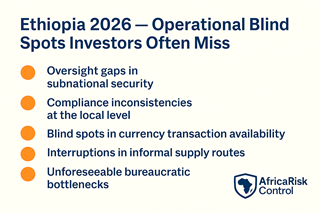 As Ethiopia enters 2026, operational risks are becoming increasingly complex and uneven across regions. Africa Risk Control’s (ARC) field-level intelligence shows that many investors and multinational operators overlook critical on-the-ground blind spots during due-diligence and project planning stages. These gaps often result in delays, increased costs, misaligned partnerships, and—more importantly—incorrect assumptions about operational feasibility.
ARC Launches Ethiopia Micro Risk Brief as Rapid Shifts Redefine 2026 Outlook
 Africa Risk Control (ARC) has released its Ethiopia Micro Risk Brief — Q1 2026, a compact intelligence product designed for organizations requiring a sharper, faster interpretation of Ethiopia’s rapidly evolving operating environment.
Where Investors Misread Ethiopia’s Risk Landscape: Why It Matters for 2026

As Ethiopia approaches 2026, the gap between investor expectations and ground realities is widening. Africa Risk Control (ARC)’s field-level assessments show that many multinational companies, advisors, and development partners continue relying on outdated assumptions formed during the 2021–2023 period. While Ethiopia still presents major long-term potential, the risk environment has shifted—requiring updated intelligence, closer monitoring, and more structured due diligence.
Why Updated Intelligence Matters More Than Ever for Investors and Operators
As Ethiopia moves toward 2026, the need for timely and field-verified intelligence has never been more critical. Political dynamics continue to evolve, foreign-exchange constraints persist, and security realities remain regionally uneven. For investors, development partners, and multinational operators, outdated assumptions can create costly miscalculations. Africa Risk Control’s (ARC) analysis shows that the decisions made in the next 12 months will significantly affect long-term project feasibility and risk exposure.
Why Investors Are Reassessing Operational Exposure
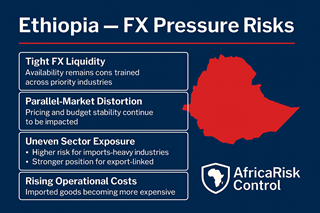 Foreign-exchange pressure has become one of the most decisive macroeconomic variables shaping Ethiopia’s investment climate heading into 2026. While the country’s long-term fundamentals remain compelling, FX constraints continue to influence pricing, working capital, procurement cycles, and overall cost structures across multiple sectors. Today’s ARC Intelligence Insight explores why FX conditions remain a central consideration for investors and operational teams preparing for 2026.
Ethiopia’s FX Outlook for 2026: Why Liquidity Stress Remains a Critical Investor Concern
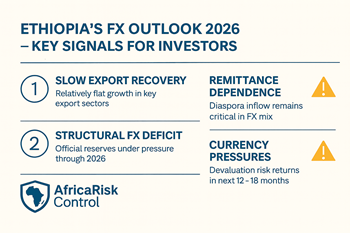 Foreign-exchange pressure remains one of the most defining macroeconomic realities shaping Ethiopia’s investment environment as the country moves toward 2026. Africa Risk Control’s (ARC) latest analysis shows that FX constraints continue to influence operational feasibility, project timing, supply-chain stability, and overall cost structures across multiple sectors. For investors preparing long-term strategies or evaluating market-entry decisions, understanding Ethiopia’s FX trajectory is essential.
What Global Investors Are Asking ARC About Ethiopia’s 2026 Outlook
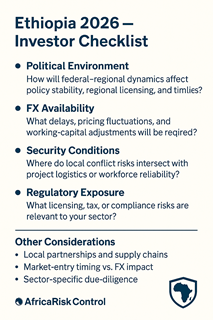
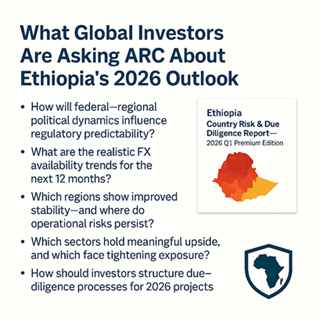 As Ethiopia moves toward 2026, the questions raised by investors, development partners, and multinational operators are becoming more focused and more urgent. Africa Risk Control (ARC) has observed a noticeable shift in the type of intelligence and risk-related insights global institutions request. This reflects the evolving nature of Ethiopia’s political, economic, and security environment — and the need for more grounded due-diligence inputs.
Africa’s Oil & Gas Outlook 2026: The Shifts Investors Can’t Ignore
 Africa’s oil and gas landscape is entering a decisive turning point in 2026 — one where legacy assumptions no longer match ground realities. Production is expected to hover around 7 million barrels per day, but the distribution of that output, the drivers of policy change, and the geography of new investments are shifting sharply across the continent.
Ethiopia 2026: Key Investor Considerations as Political, FX, and Security Pressures Persist