
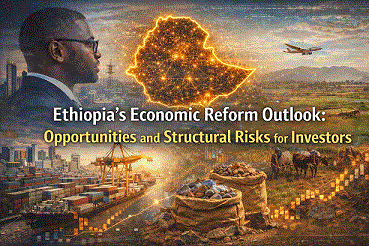
 Across Africa’s rapidly evolving economies, Ethiopia represents one of the continent’s most complex and consequential investment environments. With a population exceeding 120 million and a government pursuing gradual economic liberalization, the country offers substantial long-term opportunities in manufacturing, infrastructure, agriculture, and digital services.
Yet these opportunities are accompanied by structural risks that investors must carefully evaluate.
Over the past several years, Ethiopian authorities have introduced policy reforms designed to attract foreign investment and modernize key sectors. These initiatives include partial liberalization of telecommunications, reforms in logistics and foreign exchange management, and the gradual opening of sectors previously dominated by state enterprises.
International financial institutions have supported these reforms as part of broader economic restructuring efforts. According to the International Monetary Fund, Ethiopia’s reform agenda aims to stabilize macroeconomic conditions while strengthening private-sector participation in the economy.
Similarly, the World Bank has emphasized Ethiopia’s long-term growth potential, particularly in manufacturing and infrastructure development, noting that the country’s large domestic market and strategic location within East Africa position it as a potential regional industrial hub.
However, the investment landscape remains shaped by several critical challenges. Foreign exchange shortages continue to affect businesses operating in the country, particularly those dependent on imported inputs. Currency management policies and restrictions on profit repatriation have historically been among the primary concerns cited by international investors.
In addition, regulatory transitions can create uncertainty as government institutions adjust to evolving market frameworks.
Political dynamics also influence investor confidence. Ethiopia’s federal structure and ongoing regional tensions introduce potential disruptions that companies must consider when assessing operational risk.
Despite these challenges, the country retains considerable long-term potential. Ethiopia’s manufacturing sector – particularly textiles, agro-processing, and light industry—continues to attract international companies seeking access to competitive labor markets and growing regional trade opportunities.
The expansion of the African Continental Free Trade Area (AfCFTA) is expected to further enhance Ethiopia’s integration into continental supply chains.
For investors, the key lesson is that Ethiopia represents neither a purely high-risk environment nor an uncomplicated growth story. Rather, it is a complex market where opportunities and risks coexist.
Successful market entry therefore depends on rigorous due diligence, careful partner selection, and ongoing risk monitoring.
Companies seeking to enter or expand within Ethiopia should prioritize:
• verification of local partners and ownership structures
• assessment of regulatory compliance risks
• evaluation of supply chain exposure
• monitoring of political and economic developments
ARC provides investigative due diligence, corporate intelligence, and market entry advisory services across Ethiopia and other African markets. Learn more about our services