
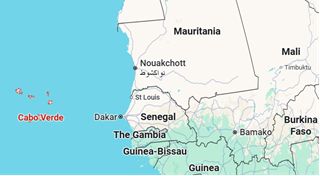
By Africa Risk Control – Cape Verde — officially Cabo Verde — remains one of Africa’s most stable and institutionally reliable nations, a rarity in a region often marked by political turbulence and economic shocks.
With a population of just over 600,000 and a GDP of around USD 2.3 billion, the island state has built a strong reputation for democratic governance, effective public institutions, and steady development progress. Its strategic position in the central Atlantic — roughly midway between Africa, Europe, and the Americas — continues to shape its geopolitical and commercial relevance, especially as global maritime, aviation, and digital corridors shift.
Although the archipelago lacks natural resources and faces geographic isolation, the country has compensated through governance excellence and a service-driven development strategy centred around tourism, marine resources, renewable energy, and digital transformation. Cape Verde consistently ranks among Africa’s best performers in rule of law, civil liberties, transparency, and press freedom — giving it an institutional credibility attractive to foreign investors seeking predictable environments.
Tourism & Hospitality: The Main Engine of Growth
Tourism remains the backbone of Cape Verde’s economy, contributing over a quarter of GDP and offering the clearest path for foreign direct investment. Visitor arrivals are rebounding strongly, especially from Western Europe, driven by the island’s reputation for safety, warm climate, and lifestyle appeal.
Large-scale resort chains dominate Sal and Boa Vista, but new investor openings are growing in eco-tourism, nautical tourism, boutique hotels, and wellness retreats. European operators — particularly from Portugal, Germany, and the UK — continue to expand, but there is room for new entrants as the government accelerates zoning reforms and encourages lower-impact, high-value tourism.
Renewable Energy Ambitions
Cape Verde’s ambition to reach 100% renewable energy by 2030 makes it one of Africa’s most forward-leaning clean-energy markets. Its strong wind patterns, high solar radiation, and emerging wave-energy potential create opportunities for independent power producers, grid modernization firms, and energy-storage providers.
The government’s regulatory alignment with European standards enhances investor protection, while ongoing improvements in procurement transparency make the energy sector one of the most promising long-term investment areas.
Blue Economy & Maritime Potential
Few African states possess a maritime domain as large as Cape Verde’s — an Exclusive Economic Zone of nearly 700,000 square kilometres. This underpins growing opportunities in fisheries, marine conservation projects, seafood processing, aquaculture, and ocean-based biotechnology.
Cape Verde’s ports, particularly Mindelo and Praia, serve as critical mid-Atlantic transit points, and the government is attempting to position the country as a maritime logistics and services hub. However, challenges remain in policing IUU fishing and strengthening maritime security, areas where private partners can play a significant role.


flashpoints, and social tensions are reshaping the investment environment fast. Get ARC’s
verified 2026 risk intelligence to avoid costly missteps and make informed decisions now.
ARC’s insights are sourced directly from our investigative journalists and on-the-ground networks across Ethiopia.
Digital Transformation & ICT Services
Cape Verde has become a continental leader in digital governance and ICT reform. Investments in digital-ID systems, e-governance platforms, and cybersecurity infrastructure are reshaping its public-service model.
This positions the country well for investment in BPO services, fintech solutions, data centres, and cloud infrastructure. Its alignment with EU AML/CFT standards also makes it an increasingly attractive jurisdiction for digital financial services targeting European-African trade flows.
Aviation, Logistics & Transport
Cape Verde’s location has long made it a potential aviation and maritime hub. As global air corridors shift and Africa-Europe connectivity changes, the archipelago sees new opportunities in air cargo, aircraft servicing, cruise-terminal upgrades, and inter-island travel solutions.
Ongoing restructuring of the national airline, TACV, opens space for strategic partnerships. Likewise, port modernization initiatives present medium-term opportunities in PPP frameworks, particularly at São Vicente.
Risks and Constraints
Despite its strengths, Cape Verde faces structural vulnerabilities. Heavy reliance on tourism makes the country sensitive to global shocks, climate-related disruptions, and changing European travel patterns.
Logistics costs remain high due to the archipelago’s geography, resulting in expensive imports and limited economies of scale. Water scarcity and chronic drought cycles continue to burden communities, agriculture, and infrastructure. State-owned enterprises, particularly in aviation and utilities, still require reform and present contingent liabilities.
Additionally, the fisheries sector faces governance challenges due to the vastness of the EEZ, limited naval capacity, and rising pressures from foreign fleets. While political stability is enviable, the small domestic market means investors must anchor their strategies in exports, digital scalability, or tourism flows rather than local consumption.
Investor Outlook
Cape Verde presents one of Africa’s most predictable and institutionally solid environments for foreign investment. The combination of democratic maturity, sector diversification efforts, digital governance, and blue-economy potential sets it apart from many continental peers.
Sectors such as renewable energy, eco-tourism, digital services, fisheries, and maritime logistics offer compelling openings for strategic investors with long-term outlooks.
For those seeking stability and governance reliability, Cape Verde stands out as a well-managed island economy with strong European ties, improving infrastructure, and clear development priorities.
ARC Advisory Note
Africa Risk Control (ARC) provides field-verified intelligence and due diligence support across 32+ African markets, including island and coastal states. Investors considering Cape Verde can benefit from ARC’s tailored country risk snapshot, local-partner verification, regulatory analysis, and sector-specific assessments across tourism, renewable energy, fisheries, and digital infrastructure.