
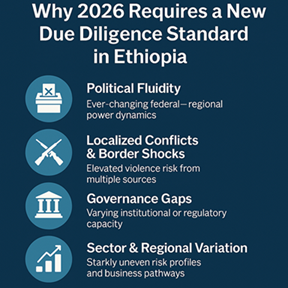
ARC’s assessments across Ethiopia show that risk indicators now change faster than many organizations expect. A partner, project site, or route that appears low-risk in January may experience new pressures by March—whether due to localized conflict, administrative changes, border spillover, or community-level dynamics. These shifts rarely appear in public reporting or official updates.
Political recalibration also contributes to unpredictable changes. The relationship between federal and regional authorities continues to evolve, influencing licensing behavior, project approvals, and institutional responsiveness. Why Ethiopia’s 2026 Environment Requires Continuous Monitoring organizations that rely on outdated political assumptions risk basing decisions on conditions that no longer exist.
Security developments follow the same pattern. Many districts remain stable for extended periods, only to experience sudden localized tensions driven by administrative disputes, land issues, or community-level incidents. These situations may be short-lived but can impact mobility, supply chains, workforce movement, and operational timelines.
In many cases, the gaps appear in places where organizations least expect them. Some project sites show consistent administrative behavior but face sporadic mobility restrictions or delays due to checkpoints, roadworks, or security operations. Others are affected indirectly by border dynamics, especially in areas influenced by Sudan’s instability.
Sector exposure reflects this variability. Logistics companies may see sudden route disruptions; agribusiness operators may experience unpredictable market flows; manufacturing firms may face FX-related operational strain; and energy or infrastructure projects may encounter access issues linked to community dynamics or regional political sensitivities.
The key challenge is that none of these changes are visible through static documentation. Registry filings, licenses, compliance documents, and contracts capture only a snapshot in time. They cannot reflect real operational realities or short-term volatility.
ARC’s Ethiopia Country Risk & Due Diligence Report — 2026 Q1 Premium Edition incorporates continuous intelligence into its methodology, combining field reporting, real-time updates, stakeholder interviews, and region-by-region monitoring. This approach provides organizations with forward-looking visibility that static reports cannot offer.
As Ethiopia navigates a critical period in 2026, decisions based solely on static documents carry growing operational, financial, and reputational risk. Organizations that integrate continuous intelligence into their due diligence and risk management processes will be better positioned to operate safely, efficiently, and competitively.