
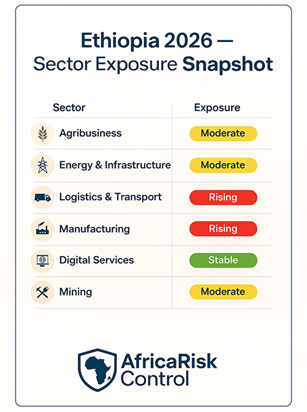
 Africa Risk Control (ARC) has reported that Ethiopia’s sector risk variations for 2026 are becoming increasingly pronounced, requiring closer examination of vulnerabilities at both national and regional levels.
According to ARC, sectors such as agribusiness, logistics, and construction face operational challenges linked to mobility issues, land-use disputes, and local governance behavior. Agribusiness continues to face mixed exposure. Production zones in some regions benefit from stabilizing conditions, while others experience localized conflict or mobility disruptions that affect harvesting, transport, and export routes. Additionally, agribusiness relies heavily on imported inputs such as machinery, chemicals, and packaging — making FX delays and procurement challenges a significant operational risk.
Energy and Infrastructure projects must navigate political sensitivities, land-access issues, and community-level dynamics. Areas with ongoing administrative inconsistency or unresolved local disputes may see slower project implementation or higher compliance burden. However, regions showing improving stability offer strong long-term potential for energy developers and infrastructure operators.
Logistics and Transport remain heavily influenced by corridor-level risk. Localized clashes, security checkpoints, and disruptions near border areas — including pressure from the Sudan conflict — influence the reliability of transport routes. ARC’s assessments show that logistics operators must plan for dynamic, region-by-region conditions rather than national-level averages.
Manufacturing exposure is tied closely to FX availability. Several manufacturing segments struggle with extended lead times for imported inputs, spare parts, and equipment. These challenges can influence production cycles, inventory levels, and pricing. Regional variation also affects labor availability, local transport networks, and regulatory oversight.
Digital Services and Tech remain among the most resilient sectors, benefiting from Ethiopia’s growing urban demand and relatively lower exposure to mobility constraints. However, regulatory changes and licensing shifts remain a consideration for operators in fintech, telecom, and digital platforms.
Mining continues to face exposure linked to informal activity, regional disputes, and environmental compliance issues. Investors must consider both security factors and partner reliability during early-stage due diligence.
ARC’s Ethiopia Country Risk & Due Diligence Report — 2026 Q1 Premium Edition provides a forward-looking breakdown of sector-specific exposure, mapping where risks are rising, stabilizing, or shifting due to regional security dynamics, FX-linked pressures, and administrative behaviors across institutions.
For organizations entering Ethiopia in 2026, understanding sector exposure is essential for accurate risk modeling, strategic planning, and investment timing.
Book 1-Hour Country Intelligence Briefing with ARC Lead Researcher