
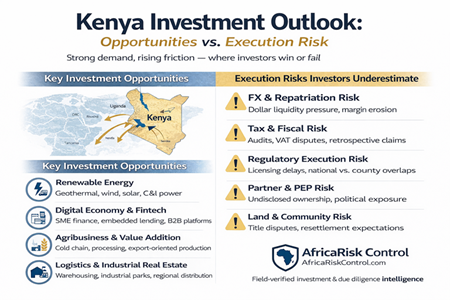
 Kenya has long been regarded as East Africa’s most sophisticated investment destination. It hosts the region’s deepest financial sector, the most diversified private economy, and a critical logistics and services hub serving Uganda, Rwanda, South Sudan, eastern Democratic Republic of Congo, and northern Tanzania. For multinational firms, private equity funds, DFIs, and regional operators, Kenya often functions as both a market in its own right and a strategic base for wider African expansion.
Yet the Kenya investment story has evolved. While opportunities remain substantial, the operating environment has become more complex. Success today depends less on identifying attractive sectors and more on managing execution, regulatory, fiscal, and counterparty risk. Investors who rely on outdated assumptions increasingly face delays, disputes, or capital impairment. This ARC Insight assesses where Kenya remains compelling for investors—and where risk is now most frequently underestimated.
Key Investment Opportunities
Despite macroeconomic pressure and fiscal constraints, several sectors continue to attract sustained investor interest.
Renewable Energy and Power Solutions
Kenya remains Africa’s leader in geothermal power and has made significant progress in wind and solar generation. Beyond grid-scale projects, demand is growing rapidly for commercial and industrial (C&I) power solutions. Manufacturers, data centers, agribusiness processors, and industrial parks are increasingly seeking captive or hybrid power arrangements to reduce costs and improve reliability. Opportunities exist across generation, EPC services, energy storage, and mini-grid solutions, particularly where projects can secure long-term offtake agreements.
Digital Economy and Fintech
Kenya’s digital ecosystem is maturing beyond consumer payments. Growth is shifting toward SME finance, embedded lending, B2B platforms, logistics technology, agri-tech, and enterprise software tailored to African operating conditions. Investors are increasingly focused on scalable revenue models, regulatory alignment, and profitability rather than user growth alone. Strategic acquisitions and minority growth investments are becoming more common than early-stage greenfield plays.
Agribusiness and Value Addition
Agriculture remains under-leveraged relative to Kenya’s regional market access. Export-oriented horticulture, dairy, grains, and processed foods offer strong upside when paired with cold-chain logistics, storage, processing, and compliance capabilities. Value addition—rather than primary production—continues to offer the most resilient returns, particularly where investors can integrate supply chains and reduce post-harvest losses.
Logistics, Warehousing, and Industrial Real Estate
Kenya’s role as a regional distribution hub underpins growing demand for warehousing, last-mile logistics, and industrial parks. Expansion of port, rail, and road infrastructure has strengthened this trend, although execution bottlenecks remain. Investors with strong local operational partners and long-term tenants are best positioned to capture stable returns.
Major Players in Key Sectors
Kenya’s investment landscape is shaped by a mix of state institutions, private sector champions, and development financiers. Sector regulators and line ministries exert significant influence over licensing and approvals, while county governments play an increasingly important role in land access, permits, and local compliance.
Market anchors include large local conglomerates, regional banks, energy producers, agribusiness exporters, telecom-linked digital platforms, and logistics operators with cross-border footprints. Development finance institutions and multilateral lenders remain active, particularly in energy, infrastructure, climate finance, and agribusiness value chains.
However, ARC frequently observes that investor risk arises not from competition with these players, but from misaligned partnerships with intermediaries whose influence is political rather than operational.
Risks and Challenges
Foreign Exchange and Repatriation Risk
Currency pressure remains a central concern for foreign investors. Dollar liquidity constraints affect import-dependent sectors and can complicate dividend repatriation, debt servicing, and supplier payments. Investors who fail to stress-test FX exposure or structure contracts accordingly often face margin erosion.
Fiscal and Tax Enforcement Risk
Kenya’s fiscal position has driven more aggressive tax enforcement. Foreign-owned firms are increasingly exposed to audits, VAT disputes, withholding tax assessments, and retrospective claims. Tax risk is frequently operational rather than legal—arising from interpretation, documentation, or inconsistent enforcement.
Regulatory Execution Risk
While Kenya’s formal policy framework is relatively advanced, execution remains uneven. Licensing timelines, overlapping mandates between national and county authorities, and informal administrative bottlenecks regularly delay project implementation. Investors often underestimate the time and resources required to secure and maintain compliance.
Political and Social Risk
Kenya’s political environment is competitive and highly mobilized. Protest cycles, election-related tensions, and policy signaling can disrupt logistics, operations, and consumer confidence. While systemic instability risk remains low, episodic disruptions are common and must be planned for.
Partner and Counterparty Risk
One of the most frequent causes of investment failure in Kenya is inadequate partner due diligence. Undisclosed politically exposed persons (PEPs), beneficial ownership opacity, prior litigation, tax liabilities, or conflicting interests often emerge only after capital is committed. Politically connected partners may accelerate early approvals but expose investors to long-term compliance and reputational risk.
Land, Title, and Community Risk
For projects involving land or infrastructure, title integrity and community engagement remain critical. Disputes over land ownership, resettlement expectations, or community consent can halt projects even after regulatory approval has been obtained.
Risk Mitigation Strategies
Successful investors in Kenya increasingly apply structured risk controls before and during market entry:
- Enhanced due diligence on partners, shareholders, directors, and key intermediaries, including beneficial ownership, PEP exposure, litigation history, and reputational risk
- FX and fiscal planning, including conservative revenue assumptions, pricing clauses, phased capital deployment, and local cost alignment
- Regulatory pathway mapping to identify all required approvals, responsible authorities, and realistic timelines at both national and county levels
- Contractual protections, including clear termination rights, dispute resolution mechanisms, and step-in provisions where feasible
- Operational controls such as third-party vendor vetting, audit trails, and integrity reporting mechanisms
- Community and ESG engagement strategies to secure and maintain social license, particularly for land-intensive projects
Investors who integrate these measures early significantly reduce execution risk and capital loss.
What ARC Verifies Before You Commit Capital
Before investors sign or deploy funds in Kenya, ARC verifies beneficial ownership and control structures, PEP exposure, litigation and regulatory history, tax posture, land and permit integrity, counterparty track records, and on-the-ground political and social risk signals. Our analysis is built on field intelligence, not desk research.
Kenya remains one of Africa’s most compelling investment destinations—but it is no longer forgiving of weak preparation. Opportunities in energy, digital services, agribusiness, and logistics are real, yet most failures today stem from execution, compliance, and partner risk rather than market fundamentals.
For investors willing to verify before they trust and plan for friction rather than ideal conditions, Kenya continues to offer durable, scalable returns. For deeper sector intelligence or a Kenya-specific due diligence briefing, contact Africa Risk Control.