
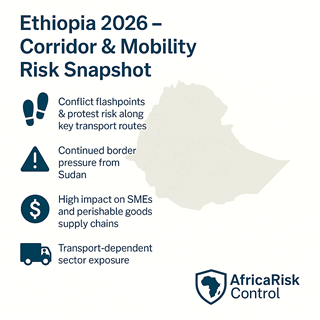
 Africa Risk Control (ARC) has highlighted increasing mobility disruptions and corridor volatility that could influence Ethiopia’s transport and logistics sector in 2026. These developments pose a significant challenge for industries dependent on consistent movement of goods.
ARC’s new report, Ethiopia Country Risk & Due Diligence Report: Premium Edition 2026 / Q1, finds that several strategic transport corridors face periodic interruptions linked to security operations, administrative variations, and community-level tensions. These disruptions — even when temporary — can create significant delays in delivery schedules, affecting supply chains and project timelines.
The organization notes that corridor volatility affects agribusiness exports, manufacturing supply chains, humanitarian operations, and cross-regional trade. ARC also highlights the influence of Sudan’s conflict on mobility patterns in Ethiopia’s western regions. ARC recommends that investors include contingency planning, alternative routing, and field-level corridor monitoring in their 2026 strategies.
The report shows that sector exposure varies significantly
• Logistics and transport companies remain directly vulnerable to corridor disruptions, affecting service reliability and cost structures.
• Agribusiness operations depend on moving inputs and harvests between regions, making mobility planning essential during peak production periods.
• Energy and infrastructure projects face challenges transporting technical equipment, construction materials, and field teams through areas with shifting security conditions.
• Manufacturers relying on imported inputs may experience extended delays when overland transport links are restricted or unpredictable.
ARC’s Ethiopia Country Risk & Due Diligence Report — 2026 Q1 Premium Edition includes a comprehensive assessment of mobility risk, incorporating field reporting, corridor-level mapping, and region-specific indicators. The report highlights which areas show stable operating windows, where volatility is rising, and what investors should consider when planning deployments, supply chains, or regional logistics.
As Ethiopia enters a critical period in 2026, understanding corridor and mobility dynamics is not simply an operational necessity — it is a strategic requirement. Organizations that integrate mobility risk into their planning processes will be better positioned to protect timelines, manage costs, and maintain business continuity.
Request Your Free Executive Summary including all the table of contents
Get the full Ethiopia 2026 Premium Report
Book 1-Hour Country Intelligence Briefing with ARC Lead Researcher