
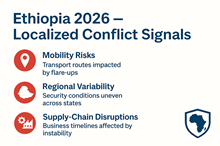
 Africa Risk Control (ARC) has highlighted increasing conflict-linked pressures that could influence Ethiopia’s operating landscape heading into 2026. While national stability indicators suggest gradual improvement, ARC’s field intelligence shows that several regions continue to face intermittent tensions.
The organization notes that localized clashes, land disputes, and community-level friction remain active in certain districts. These issues, though often short-lived, disrupt mobility, transport corridors, and workforce access. ARC reports that these micro-level dynamics have significant implications for logistics-dependent sectors such as agribusiness, humanitarian operations, and manufacturing.
Spillover from the conflict in Sudan continues to shape security conditions along Ethiopia’s western borders, affecting trade routes and the movement of goods. ARC notes that these pressures increase unpredictability for companies operating in frontier regions.

Political shifts at the federal and regional levels also influence conflict dynamics, as alliances and administrative decisions evolve. ARC warns that these changes may alter security responses or increase volatility in certain areas.
The organization concludes that companies preparing for 2026 must incorporate district-level risk mapping into their due-diligence processes to avoid operational disruption.
Africa Risk Control’s Ethiopia 2026 Premium Report provides deeper political scenarios, region-level mapping, FX diagnostics, regulatory exposure, and due-diligence guidance.
Get the full premium Africa Risk Control’s report here with one hour intelligence briefing call with our country desk chief: https://lnkd.in/dzcKmfTA
Request free Summary: [email protected]
Get Ethiopia Micro Risk Brief Q1/2026
You can also book Supplementary Intelligence Briefing call here
Ethiopia Country Risk Profile 2026 is also Now Available.
To Learn More About Africa Risk Control’s Services, Book A 20-Minute Free Consultation Here.