
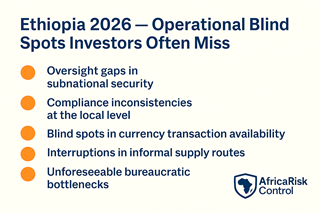
 As Ethiopia enters 2026, operational risks are becoming increasingly complex and uneven across regions. Africa Risk Control’s (ARC) field-level intelligence shows that many investors and multinational operators overlook critical on-the-ground blind spots during due-diligence and project planning stages. These gaps often result in delays, increased costs, misaligned partnerships, and—more importantly—incorrect assumptions about operational feasibility.
One of the most significant blind spots relates to intra-country regional variation. Ethiopia cannot be assessed through a single, national-level lens. Political dynamics, administrative efficiency, mobility constraints, and security exposure differ widely between regions. Investors who treat Ethiopia as a uniform environment risk misunderstanding where their supply chains, staffing, or partner networks may face friction.

A second blind spot is the underestimated impact of foreign-exchange (FX) delays on actual business continuity. Companies often account for FX availability at a macro level, but fail to examine how delays affect operational timelines. ARC’s on-the-ground reporting indicates that FX shortages frequently disrupt procurement cycles, spare-parts availability, and pricing stability for import-heavy sectors. In practice, these issues can extend project timelines by several weeks or even months.
Many investors also underestimate local administrative bottlenecks. Processes such as licensing, land access, environmental approvals, and regulatory compliance can vary significantly by region and institution. These variations are often not captured in publicly available sources but have real implications for cost and schedule planning.
Another overlooked factor is mobility risk. Even in relatively stable regions, disruptions can emerge along trade corridors, transport routes, or cross-regional networks. These mobility constraints affect logistics, distribution, and the ability of field teams to operate consistently. Without understanding corridor-level and district-level vulnerabilities, supply-chain planning becomes speculative at best.
Finally, investors often overlook the importance of local partner verification. ARC’s due-diligence investigations continue to uncover gaps in governance, financial transparency, history of disputes, and hidden risk flags. Companies that rely solely on referrals or basic document checks expose themselves to reputational and financial harm.
ARC’s Ethiopia Country Risk & Due Diligence Report — 2026 Q1 Premium Edition addresses these blind spots by providing field-verified analysis and forward-looking scenario models. The report helps investors build realistic timelines, identify exposure points, and design mitigation strategies tailored to their sector and operational footprint.
For organizations planning Ethiopia engagements in 2026, understanding and addressing operational blind spots early is essential. The cost of getting it wrong continues to rise—but so does the value of making informed, intelligence-driven decisions.
Request free Summary: [email protected]
Get the full Ethiopia Country Risk & Due Diligence Report — Premium Edition 2026 / Q1
Alternatively you can get the Ethiopia Micro Risk Brief — Q1 2026 – the 15 pages extract of the report, which is launched a few days ago upon the requests from its clients.