
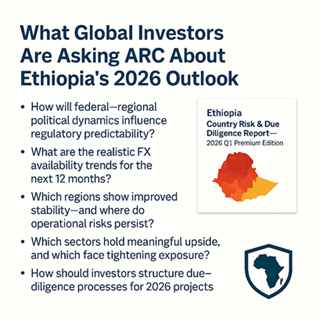
 As Ethiopia moves toward 2026, the questions raised by investors, development partners, and multinational operators are becoming more focused and more urgent. Africa Risk Control (ARC) has observed a noticeable shift in the type of intelligence and risk-related insights global institutions request. This reflects the evolving nature of Ethiopia’s political, economic, and security environment — and the need for more grounded due-diligence inputs.
Across ARC’s briefings, intelligence calls, and consultations, five major questions consistently arise. These questions reveal the strategic uncertainties shaping investor decisions and highlight why Ethiopia’s 2026 outlook requires more contextualized risk analysis.
The first question relates to political predictability. Investors want to understand how federal–regional dynamics may influence regulatory timelines, administrative decision-making, and policy continuity in 2026. Ethiopia is undergoing a period of political recalibration, and the balance of influence between national and regional actors continues to shape the investment climate. Institutions ask ARC whether the political environment is stabilizing, diversifying, or entering a new phase of fluidity.
The second area of inquiry involves foreign-exchange availability. FX pressure remains a central concern, influencing everything from imports and working capital to pricing and feasibility assessments. Investors want clarity on whether FX constraints will tighten further, ease slightly, or remain stable. They also want to understand the implications for sectors dependent on imported inputs or foreign financing.
A third recurring question concerns the current security landscape. While certain regions have seen improvements, others continue to experience episodic disruptions that affect logistics, mobility, and operations. Investors ask ARC where the practical risks lie, which areas are stabilizing, and what patterns may be expected in 2026.
Fourth, global firms increasingly ask about sector risk asymmetry — which sectors hold meaningful upside, and which face heightened exposure due to operational, regulatory, or FX-linked pressures. ARC’s forward-looking sector assessments help identify not only where opportunities exist, but what risks may accompany them.
The last major question concerns due-diligence depth. More organizations want to understand what a modern, 2026-ready due-diligence process looks like: document-based checks, localized field verification, stakeholder mapping, region-level risk assessments, and compliance-focused investigations.
These five questions reflect the issues shaping Ethiopia’s 2026 operating environment and form the basis of ARC’s Ethiopia Country Risk & Due Diligence Report — 2026 Q1 Premium Edition. The 107-page report provides deeper insights across political scenarios, FX diagnostics, security patterns, regulatory exposure, and sector risk.
Request the Executive Summary: [email protected]
Buy the full Premium Report
Book a 20-minute consultation to discuss your due-diligence and intelligence needs
 Ethiopia Country Risk & Due Diligence Report
2026 Q1 Premium Edition
A 107-page intelligence report covering political, FX, security, conflict, regional vulnerabilities, and sector-specific risks.