
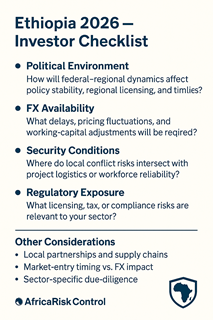
Today’s ARC Investor Checklist is designed to provide a high-level orientation for investors assessing market-entry strategies, expansion plans, or operational exposure in Ethiopia during 2026. This is not a substitute for a full due-diligence process; rather, it serves as an essential early-stage guide to help investors identify the areas requiring closer scrutiny.
One of the most critical considerations for 2026 is the political environment. While national reform efforts continue, the relationship between federal and regional authorities remains fluid, influencing policy consistency and administrative predictability. Investors entering Ethiopia’s regions should understand how local political dynamics can affect licensing, land access, workforce stability, regulatory implementation, and partnership approvals.
Africa Risk Control (ARC) offers comprehensive country risk analysis and investment advisory services to assist investors in navigating Ghana’s dynamic market. Our expertise ensures informed decision-making and strategic planning.
 Ethiopia Country Risk & Due Diligence Report
2026 Q1 Premium Edition
A 107-page intelligence report covering political, FX, security, conflict, regional vulnerabilities, and sector-specific risks.
Foreign-exchange availability remains another central issue. Ethiopia continues to experience liquidity shortages and parallel-market distortions affecting import-heavy operations. Investors must plan around FX delays, pricing fluctuations, and working-capital adjustments, particularly in sectors dependent on imported inputs, machinery, or foreign financing.
Security conditions vary widely across the country. Some regions have stabilized, while others experience episodic disruptions that can hinder logistics, mobility, and project execution. Understanding these localized patterns — rather than relying on purely national-level assessments — is essential for reducing operational risk.
Regulatory exposure also requires careful review. Ethiopia is undergoing policy adjustments across sectors such as telecom, logistics, agriculture, construction, and finance, but reform timelines and outcomes remain uneven. Investors must map the regulatory risks specific to each sector and project type, including licensing requirements, compliance updates, tax provisions, and the pace of regulatory enforcement.
The Investor Checklist published today highlights these issues and more, offering a structured snapshot of the major considerations shaping investment decisions in 2026. It complements ARC’s Ethiopia Country Risk & Due Diligence Report — 2026 Q1 Premium Edition, a 107-page intelligence product that provides region-level vulnerability mapping, political scenarios, FX diagnostics, conflict-hotspot analysis, and sector-specific due-diligence recommendations.
Organizations preparing for 2026 will benefit from pairing today’s checklist with ARC’s deeper field-based intelligence to ensure greater clarity, safer decision-making, and increased operational resilience.
