
 By Africa Risk Control (ARC) – Burkina Faso is a landlocked country of approximately 23 million people in the Sahel region of West Africa. Despite its geographical disadvantage and ongoing security challenges, the economy is showing signs of recovery. According to the World Bank the economy grew by 4.9 % in 2024, up from 3.0 % in 2023 and nominal GDP stood at about USD 23.25 billion in 2024.
Macroeconomic indicators are gradually stabilising: inflation rose to about 4.2% in 2024 (from near 0.7% in 2023) as food-prices spiked. Fiscal and current-account deficits are narrowing. The government remains committed to regional integration (via Economic Community of West African States / WAEMU) and structural projects—but the security and logistics burdens are significant.
For investors evaluating entry into Burkina Faso, the big picture is one of a frontier economy with real potential—yet one that demands a clear understanding of risks, and a readiness to engage with a complex environment.
Key Investment Opportunities
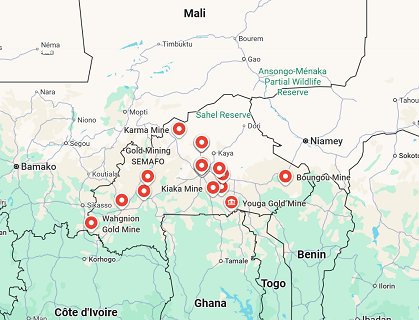
Mining & Natural Resources: Gold dominates Burkina Faso’s export base, offering one of the clearest entry points for investors. With global gold prices elevated and new licences being issued for base metals (zinc, manganese) and other extractives, mining remains a major growth engine. According to the World Bank, the rebound in the secondary sector in 2025 is expected to be driven by increased gold production.
Agriculture & Agribusiness: Over 80% of the population depends on agriculture (subsistence or commercial) and the government is pushing to add value through processing (sesame, shea, cotton, livestock). With Burkina Faso’s favourable agro-ecology (for this region) and under-utilised land, agribusiness presents opportunities especially for foreign firms willing to partner locally.
Energy & Infrastructure: Electricity access remains low (the World Bank reports about 21.7 % of population had access to electricity in 2023) in Burkina Faso.
That gap signals room for solar, off-grid and mini-grid investments. A recent solar-power project at Donsin (25 MW) underlines the potential.
Wikipedia
Digital/FinTech & Services: Mobile-penetration and digital services are growing in West Africa and Burkina Faso is no different. Investors in fintech, digital payments, and ICT infrastructure may find first-mover advantage in a market with limited legacy systems.
Public-Private Partnerships (PPPs) & Infrastructure: Given the country’s logistics constraints (being landlocked) and infrastructure deficits (roads, rail, power, ports via neighboring countries), PPPs offer ways to participate in enabling services that support all sectors—mining, agriculture, commerce.
Major Players in Key Sectors
In mining, several international players are present (Canada- and Australia-based firms) as well as regional firms operating in gold and base-metal exploration. In agriculture, the national cotton company (Société Fibres Textiles du Burkina) remains a major stakeholder though value-chain diversification is opening to private-investor involvement.
In the energy/digital arena, domestic utilities (Société Nationale d’Électricité du Burkina Faso) and regional telecom operators are key. For an investor, the strategic move may involve teaming with a domestic “champion” to navigate regulation, logistics and local knowledge.
For example, an international mining firm entering Burkina should assess whether to partner with the national mining company or work directly via license—this will affect timelines, community engagement and operational risk.
Economic & Business Environment Trends
Growth in Burkina Faso has been moderate but improving: The World Bank estimates growth of ~4.7 % in 2025 under favourable conditions. GDP per capita remains low (USD ~944 in 2024).
Inflation remains manageable but vulnerable to shocks (food, energy). The fiscal deficit narrowed in 2024 to about 5.6% of GDP.
Trade is dominated by gold and cotton exports, and dependency on external financing remains. The business climate is improving—reforms in registration, investment code and regional tariff regimes—but remains behind many regional comparators.
From a foreign‐investor perspective, Burkina Faso sits in the “challenger frontier” category: higher risk than mature markets, but with upside if properly executed.
Risks & Challenges
Security & Political Instability: Burkina Faso suffers from jihadist insurgency in northern and eastern regions, periodic coup risk and changing governments. This impacts investor confidence, insurance costs and logistics.
Landlocked & Logistics Bottlenecks: Transport and export costs are higher relative to coastal economies. Exporters must factor in road/rail linkages into coastal ports, and border/duty complexities.
Regulatory & Institutional Weakness: Bureaucratic delays, weak transparency, limited local labour skills, and under-developed infrastructure raise project risk.
Climate & Agricultural Vulnerability: With agriculture a backbone of exports/employment, variable rainfall (Sahel zone) and climate change represent systemic risks.
Macro & External-Shock Risk: Though deficits are improving, the economy remains exposed to commodity-price fluctuations (gold) and external financing. Currency risk is lower (CFA franc pegged) but inflation and global interest rates still matter.


Risk Mitigation & Investor Considerations
Partner Locally: Working with a well-connected local firm reduces operational & regulatory risk, improves access to community networks and accelerates approvals.
Thorough Due Diligence: Evaluate land titles, mining licences, local content obligations, environmental/social risks, supply‐chain logistics and exit strategies.
Diversify and Build Buffer: Spread exposures across sectors (mining + agribusiness + services) or across neighboring countries to mitigate country-specific shock.
Engage with Regional Institutions & Donors: The economy receives support from the World Bank, African Development Bank, and others—leveraging concessional finance or blending instruments reduces cost and risk.
Focus on Value-Addition: Investing further down the value chain (e.g., gold-refining in-country, agriprocessing) rather than simple extraction/export enhances margin and offers differentiation. For example, the government has signalled interest in developing a domestic gold refinery under the new mining law.
Monitor Security & Macro Trends Closely: Use real-time intelligence (for example via your investigative network) to map security hotspots, regional border dynamics, and local political developments.
In conclusion, over the medium term (2025-27), assuming stable security and weather conditions, GDP growth could strengthen to 5-1 %-plus, offering yield further above risk levels. The World Bank forecasts ~5.1% by 2027.
For foreign investors with a tolerance for frontier-market risk, Burkina Faso offers notable upside: key sectors (mining, agribusiness, energy) are underserved and positioned for growth, and early entrants may secure competitive positioning.
However, success will depend on rigorous due diligence, local partnerships, and strategic risk management. In essence, Burkina Faso is not for the faint-hearted, but for those prepared, it presents a frontier investment opportunity in West Africa’s Sahel region.
At Africa Risk Control (ARC), we help investors, development partners, and corporations navigate complex markets like Burkina Faso with confidence. Our team combines on-the-ground intelligence, investigative due diligence, and risk analysis to uncover real business realities—beyond the numbers. Whether you’re evaluating a mining project, assessing a local partner, or planning regional expansion, ARC delivers the clarity and assurance you need before committing capital.
Reach out to our analysts for tailored country risk assessments or in-depth due diligence across Africa.